
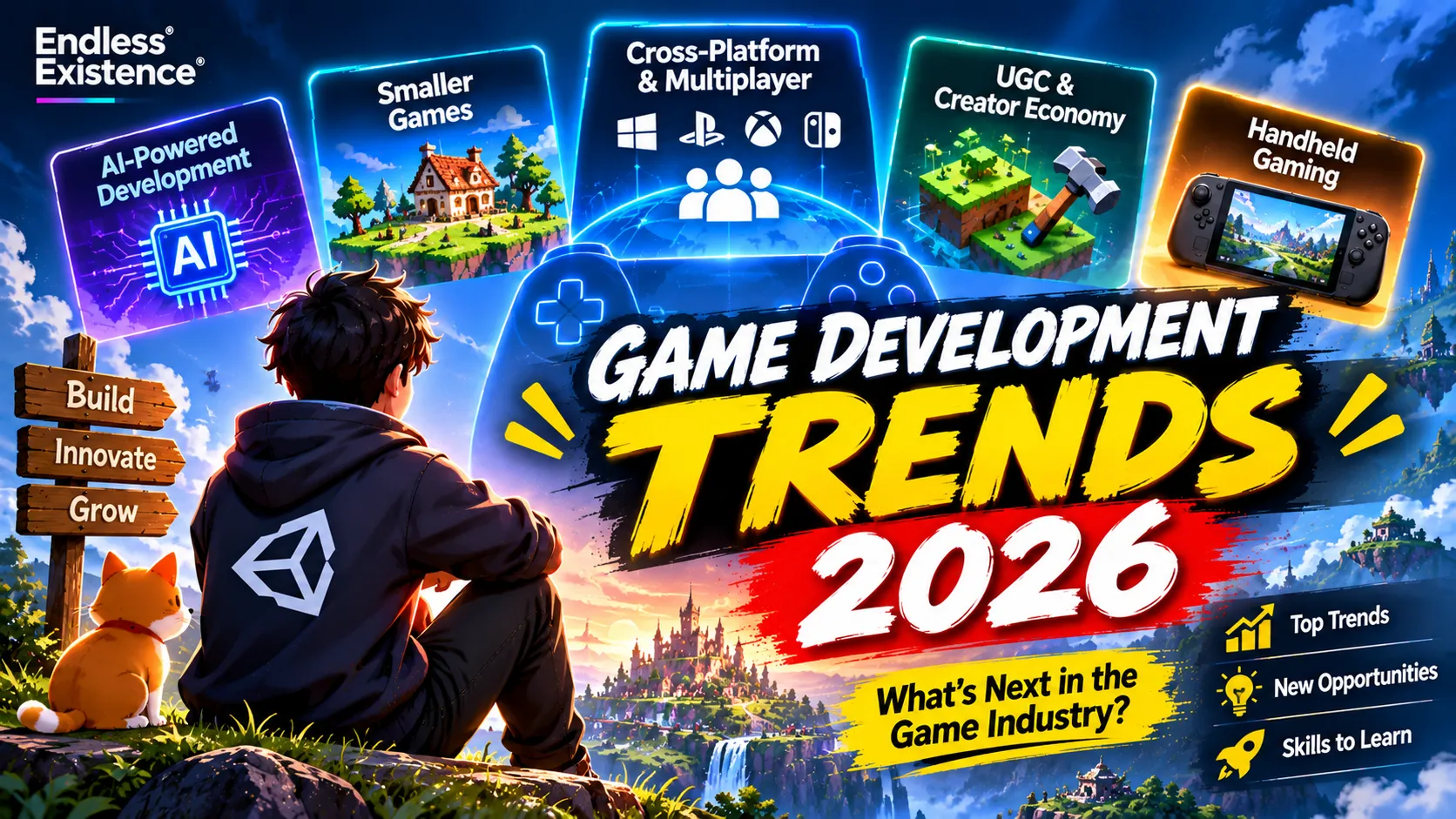
The game development industry is evolving faster than ever. New technologies, changing player expectations, AI-powered workflows, and emerging platforms are reshaping how games are designed, developed, published, and monetized.
In 2026, game development is no longer just about creating impressive graphics or building massive virtual worlds. Developers are increasingly focused on production efficiency, player engagement, cross-platform experiences, community-driven content, and sustainable business models.
For indie developers and established studios alike, understanding these changes is essential.
So, what are the biggest game development trends in 2026? Which technologies are worth learning? And how can developers take advantage of these opportunities?
Let’s explore the trends shaping the industry.
1. AI-Assisted Game Development Is Becoming More Practical
Artificial intelligence remains one of the most discussed technologies in game development. However, the conversation is becoming more practical.
Instead of expecting AI to independently create complete games, developers are increasingly using it to improve specific parts of their workflows.
Common applications include:
- AI-assisted programming and debugging
- Automated testing and bug detection
- Game design brainstorming
- Dialogue and narrative development
- Documentation and technical research
- Concept exploration and prototyping
- Production planning and workflow automation
The 2026 Unity Game Development Report found that 73% of surveyed studios reported improved efficiency through AI adoption. Coding assistance was one of the major use cases.
However, AI adoption is not universally welcomed.
The GDC 2026 State of the Game Industry report found that 52% of surveyed game industry professionals believed generative AI was having a negative impact on the industry. Only 7% viewed its impact positively.
This difference between productivity benefits and industry concerns is important.
Developers must consider copyright, asset ownership, quality control, transparency, and the potential impact on creative work.
What this means for developers:
Learning to use AI effectively is becoming a valuable skill. However, understanding programming, game design, optimization, and production remains essential. AI can accelerate development, but developers still need the judgment to build good games.
2. Smaller Games and Faster Development Cycles
One of the most interesting trends in 2026 is the growing interest in smaller, more focused games.
For years, large studios competed through enormous environments, lengthy campaigns, and increasingly expensive productions. But developing a massive game involves considerable financial and technical risks.
Smaller projects offer a different strategy.
According to the 2026 Unity Game Development Report, 52% of surveyed developers said their teams were prioritizing smaller, more manageable projects.
The same report found that 67% of surveyed developers spent three months or less in the prototyping phase.
This approach allows studios to:
- Validate ideas before committing to full production.
- Reduce unnecessary development costs.
- Experiment with different gameplay mechanics.
- Release games with shorter production cycles.
- Focus on quality instead of content volume.
This does not mean large games are disappearing. Rather, smaller projects are becoming an increasingly attractive option for teams looking to manage risk.
What this means for indie developers:
You don’t need hundreds of developers to create a memorable game. A focused concept, satisfying gameplay loop, and polished experience can provide a strong foundation for a commercial release.
3. Cross-Platform Gaming and Cross-Play
Players increasingly expect games to work across different devices and platforms.
A player might start gaming on a PC, continue on a console, or play with friends using mobile devices. This creates opportunities for developers who can deliver consistent experiences across platforms.
Cross-platform development and cross-play are therefore becoming important production considerations.
The 2026 Unity report found that:
- 83% of surveyed studios supported online multiplayer features.
- 72% prioritized cross-play functionality.
- 55% focused on smaller multiplayer sessions involving 2–9 players.
Cross-play can help developers bring together communities that would otherwise be separated by platform restrictions.
However, implementing it introduces technical challenges:
- Different input methods and control schemes
- Platform-specific performance limitations
- Account and authentication integration
- Network synchronization
- Matchmaking and session management
- Fairness between different input devices
What this means for developers:
If you’re building a multiplayer game, consider cross-platform compatibility early in development. Designing networking, input handling, and account systems with multiple platforms in mind can prevent expensive architectural changes later.
4. Handheld Gaming Is Becoming a Bigger Development Target
Handheld gaming PCs are creating another opportunity for developers.
Devices such as the Steam Deck and other Windows-based handheld gaming systems allow players to enjoy PC games in a portable format.
This market is important because developers can potentially reach more players without creating an entirely separate game.
The GDC 2026 State of the Game Industry report found that 28% of surveyed developers were making or optimizing games for Steam Deck. Another 40% expressed interest in developing for the platform.
This makes handheld compatibility an increasingly relevant consideration, especially for PC developers.
What developers should consider
Performance optimization: Handheld devices often have different hardware and power constraints compared with desktop PCs.
UI scaling: Small screens require readable text, clear menus, and appropriately sized interface elements.
Controller support: Games should provide reliable controller navigation and gameplay.
Battery efficiency: Reducing unnecessary GPU and CPU workload can improve the portable experience.
Flexible graphics settings: Players should be able to adjust visual quality to balance performance and battery life.
Handheld optimization is not necessarily a separate development discipline. Many of these improvements also benefit lower-end PCs.
5. User-Generated Content Is Expanding the Gaming Experience
User-generated content, commonly known as UGC, is changing the relationship between developers and players.
Traditionally, developers created most of the content players experienced. With UGC systems, players can create their own levels, characters, experiences, maps, and game modes.
Platforms such as Roblox and Fortnite have demonstrated how creator ecosystems can become an important part of gaming communities.
The 2026 gaming outlook published by Boston Consulting Group also identifies UGC and the creator economy as major growth opportunities.
For developers, UGC can create several advantages:
- More community participation
- Additional gameplay experiences
- Longer player engagement
- Opportunities for creator monetization
- Community-driven content discovery
However, UGC systems also introduce challenges.
Developers need moderation tools, permission systems, content validation, reporting mechanisms, and appropriate safety controls.
What this means for developers:
You don’t necessarily need to build a complete creation platform. Even simple features such as custom maps, level sharing, player-designed challenges, or community competitions can make a game more interactive.
6. Discoverability Is Becoming a Major Development Challenge
Creating a good game is difficult. Getting people to discover it can be even harder.
Digital storefronts are filled with new releases, and developers must compete for limited player attention.
This makes discoverability an important part of modern game production.
The 2026 Unity Game Development Report highlights discoverability as a major challenge for studios.
Among surveyed developers:
- 62% favored online events for promoting games.
- 60% used social media as a promotional approach.
- 90% of surveyed mobile developers used platform analytics.
- 73% used industry research to guide decisions.
These findings show that marketing and analytics are increasingly connected to development decisions.
Strategies that can help
Start marketing early: Share development progress before launch.
Create short gameplay videos: Demonstrate the most interesting mechanic in a few seconds.
Build a community: Use Discord, Reddit, YouTube, and relevant gaming communities.
Study comparable games: Understand their audience, presentation, pricing, and player feedback.
Use analytics: Measure retention, session duration, conversion, and player progression where appropriate.
Improve your store page: Strong screenshots, clear descriptions, and an engaging trailer can help communicate your game’s value.
Marketing should not be treated as something that begins after development is complete.
7. Multiplayer Games Are Moving Beyond Traditional Competitive Experiences
Competitive multiplayer remains important, but social and cooperative experiences offer another interesting direction.
Not every player wants ranked matches, intense competition, or highly demanding gameplay.
Many players simply want to enjoy an experience with friends.
Co-op games, social simulations, party games, and small-session multiplayer experiences can create memorable moments through player interaction.
Examples of possible mechanics include:
- Cooperative missions
- Shared building and exploration
- Team-based objectives
- Physics-driven challenges
- Social mini-games
- Asymmetric multiplayer gameplay
The Unity 2026 report found that many studios were focusing on smaller multiplayer sessions rather than only large-scale online experiences.
For smaller development teams, this can be an attractive design direction.
A compact environment with a few interesting cooperative mechanics may be more manageable than a massive multiplayer world.
However, multiplayer still requires careful attention to networking, synchronization, matchmaking, security, and ongoing server costs.
8. Game Development Tools Are Becoming More Connected
Modern game development involves much more than a game engine.
A typical production pipeline may include:
- Version control
- Game engines
- Asset management
- Build automation
- Automated testing
- Project management
- Documentation
- AI coding assistants
- Continuous integration systems
These tools are increasingly being connected to reduce repetitive work.
One notable development is the growing use of Model Context Protocol (MCP), which can allow AI applications to interact with external tools and structured development environments through defined interfaces.
Unity’s 2026 report found that 50% of surveyed developers were using MCP servers. Among those using MCP, engine/editor connectivity and production management were important use cases.
This creates opportunities for more automated workflows.
For example, an AI assistant could potentially:
- Read project documentation.
- Inspect relevant code through an approved integration.
- Help identify an issue.
- Suggest a code change.
- Trigger an authorized test or build workflow.
- Summarize the result.
The important point is that connected tools need appropriate permissions, validation, and human oversight.
What this means for developers:
Learning how to build efficient development pipelines can become a valuable advantage, especially for small teams that cannot afford dedicated technical infrastructure departments.
9. Diversified Monetization and Sustainable Game Businesses
Another important trend is the growing need for more sustainable revenue strategies.
A game studio cannot always depend on a single source of income.
Depending on the genre and platform, developers may explore:
- Premium game sales
- Downloadable content
- Cosmetic purchases
- Expansion packs
- Subscriptions
- In-game purchases
- Creator partnerships
- Licensing opportunities
- Merchandise and collaborations
The Unity 2026 report found that 24% of surveyed studios were exploring revenue beyond core game sales.
However, monetization must fit the experience.
A premium single-player game does not necessarily need aggressive microtransactions. A free-to-play multiplayer game may require a different business model.
The goal should be to create a sustainable relationship between the game, its players, and the studio.
10. Graphics Are Evolving, but Art Direction Still Matters
Realistic graphics continue to improve through modern rendering techniques, hardware advancements, and increasingly powerful engines.
But visual quality does not always mean photorealism.
Stylized graphics, distinctive art direction, readable environments, and strong visual identities remain important.
Developers are exploring:
- Advanced global illumination
- Real-time ray tracing
- Procedural environments
- Dynamic lighting
- Stylized rendering
- Virtual production workflows
- More efficient asset pipelines
Modern engines such as Unreal Engine and Unity provide increasingly capable rendering tools, while Godot continues to offer an alternative for developers who prefer an open-source engine.
The important lesson is that visual technology should serve the game’s identity.
A well-designed stylized game can be more memorable than a technically impressive game with no distinctive visual direction.
11. Mobile Game Development Faces Increasing Competition
Mobile remains one of the largest parts of the gaming market, but releasing a mobile game has become increasingly challenging.
Developers face intense competition, rising user acquisition costs, and discoverability problems.
The 2026 Unity report identifies competition and user acquisition costs among the major challenges reported by mobile developers.
This makes several areas particularly important:
- Fast loading and efficient performance
- Simple and responsive controls
- Strong onboarding
- Meaningful progression
- Retention-focused game design
- Data-driven updates
- Effective store presentation
- Careful user acquisition planning
For mobile developers, creating an enjoyable game is only one part of the process. Understanding player behavior and distribution is equally important.
12. The Growing Importance of Technical and Creative Specialization
As development tools become more powerful, the ability to use a particular engine is not always enough to stand out.
Studios increasingly need people who can solve specialized problems.
Some important areas include:
Technical Artists: Connecting art and engineering through shaders, tools, optimization, and asset pipelines.
Network Engineers: Building reliable multiplayer systems, synchronization, matchmaking, and server infrastructure.
Gameplay Programmers: Creating responsive mechanics, controls, interactions, and game systems.
Tools Programmers: Improving editor workflows and production efficiency.
Graphics Programmers: Working with rendering, lighting, shaders, and performance.
Game Data Analysts: Understanding player behavior and helping teams make informed decisions.
For aspiring developers, this means that developing deeper technical or creative expertise can be more valuable than simply collecting experience with multiple engines.
What Should Game Developers Focus on in 2026?
Not every trend deserves equal attention. Your priorities should depend on your experience, team size, project type, and career goals.
| Developer type | Recommended focus |
|---|---|
| Beginner | Programming fundamentals, game mechanics, and small projects |
| Unity developer | C#, optimization, multiplayer, and AI-assisted workflows |
| Unreal developer | C++, Blueprints, rendering, and performance |
| Roblox developer | Lua, multiplayer systems, UGC, and monetization |
| Indie developer | Rapid prototyping, scope management, and discoverability |
| Multiplayer developer | Networking, backend systems, cross-play, and security |
| Technical artist | Shaders, procedural tools, rendering, and optimization |
| Mobile developer | Retention, analytics, performance, and user acquisition |
The biggest mistake is trying to follow every trend simultaneously.
Choose technologies and skills that directly support the games you want to build.
Final Thoughts: What Will Define Game Development in the Coming Years?
Game development in 2026 is becoming more connected, more competitive, and increasingly influenced by production technology.
AI is changing workflows. Smaller projects are becoming attractive to studios. Cross-play is expanding multiplayer possibilities. Handheld gaming is creating new optimization requirements. UGC is giving players more creative control, while discoverability and sustainable monetization are becoming essential business considerations.
But technology alone will not determine which games succeed.
Strong gameplay, thoughtful design, technical quality, and a clear understanding of players will remain fundamental.
For developers, the best strategy is not to follow every new trend. It is to understand which changes create real opportunities and learn how to use them effectively.
The future belongs to developers who combine creative thinking, technical expertise, and the ability to adapt.
Frequently Asked Questions
What is the biggest game development trend in 2026?
There is no single trend dominating every part of the industry. AI-assisted development, smaller projects, cross-play, UGC, and discoverability are among the most significant developments.
Is AI replacing game developers?
AI is automating or accelerating certain tasks, but it does not independently replace the full range of game development responsibilities. Programming, design decisions, architecture, testing, creative direction, and production judgment remain important.
Is Unity still relevant in 2026?
Yes. Unity remains an important game development engine, particularly for mobile, indie, and cross-platform projects. Unreal Engine and Godot also serve different development needs.
Is multiplayer game development worth learning?
Yes, especially if you are interested in co-op games, competitive games, social experiences, or online simulations. Networking, backend development, matchmaking, and synchronization are valuable technical skills.
Should indie developers focus on smaller games?
Smaller projects can reduce production risk and allow faster experimentation. However, the right project scope depends on the gameplay concept, target audience, team capabilities, and business model.
Which game development platform should beginners learn?
Unity, Unreal Engine, Godot, and Roblox are all valid starting points. The best choice depends on what kind of games you want to create and which development environment suits your goals.

