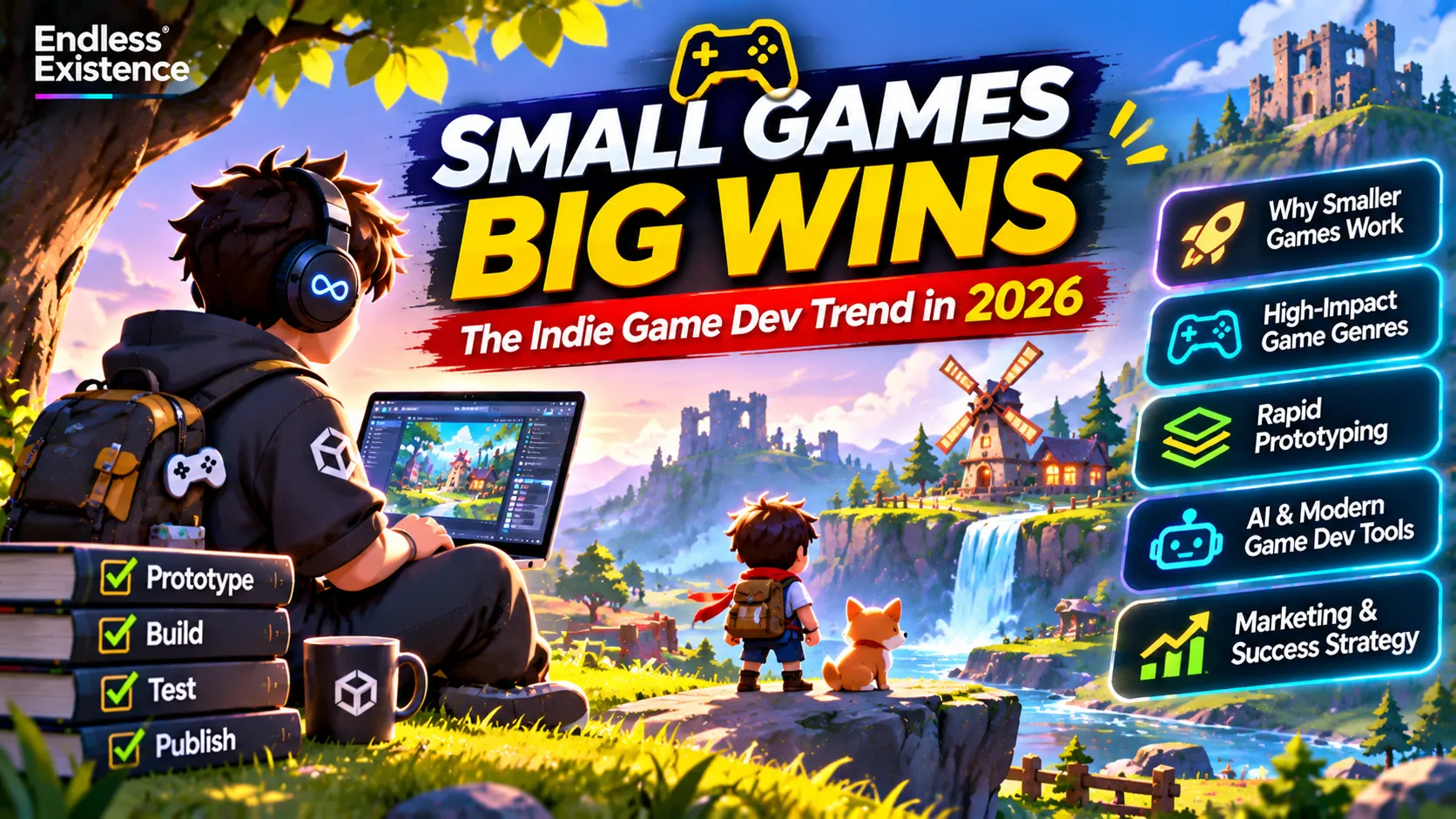
The game development industry has a new strategic direction: build smaller, validate faster, and focus on creating experiences players genuinely want to replay.
For years, many aspiring developers believed that success required massive open worlds, hundreds of quests, realistic graphics, and years of development. But the industry is challenging that assumption.
From compact co-op experiences to short-session indie hits, smaller games are demonstrating that a focused idea, satisfying gameplay loop, and strong player experience can be more valuable than sheer content volume.
This is not simply about making cheap games. It is about making smarter production decisions.
In this article, we’ll explore why smaller games are gaining attention in 2026, what makes them successful, and how indie developers can use this approach to build games with limited resources.
1. Why Is the Industry Moving Toward Smaller Games?
Game development has become increasingly expensive and competitive. Large projects require more developers, longer production schedules, complex pipelines, and substantial marketing budgets.
For smaller studios, taking on that level of risk can be difficult.
The 2026 Unity Game Development Report highlights this shift. In its survey of 300 respondents, 52% said their studios were focusing on smaller, more manageable projects. Another 20% reported significantly shortened development cycles.
The report also points to successful smaller-scale releases as examples of what focused projects can achieve.
This suggests a change in production strategy: rather than trying to compete with the biggest studios on scale, developers are looking for opportunities to deliver distinctive experiences with less production overhead.
The advantages of a smaller project
- Lower production risk: Fewer systems and assets can mean fewer expensive dependencies.
- Faster iteration: Developers can test gameplay ideas without building an enormous world first.
- Smaller teams: A focused project may be achievable with a few developers.
- Clearer identity: A game built around one strong mechanic is easier to explain and market.
- More manageable updates: Smaller projects can be easier to maintain after launch.
However, smaller does not automatically mean successful. A small game still needs excellent execution, a clear audience, and a compelling reason for players to try it.
2. The Power of One Strong Gameplay Loop
One of the biggest mistakes indie developers make is adding too many features before proving that the core gameplay is enjoyable.
Imagine a cleaning simulator.
The developer starts with a simple concept: players enter a dirty location, collect rubbish, clean stains, earn rewards, and unlock new areas.
That loop can already create a satisfying experience.
Now imagine adding crafting, pets, multiplayer trading, character customization, vehicles, dozens of tools, and a complex story before the basic cleaning mechanic feels good.
The project becomes larger, but not necessarily more enjoyable.
A better approach is to make the central loop satisfying first.
A useful gameplay loop usually contains:
- Action: The player performs a meaningful activity.
- Feedback: The game clearly communicates the result.
- Reward: The player receives progress, resources, or satisfaction.
- Motivation: A new objective encourages another round.
For example:
Explore → Collect → Upgrade → Unlock → Repeat
The loop should be enjoyable even before you introduce extensive progression systems.
3. Small Games Can Still Have Huge Replayability
A smaller game does not need hundreds of levels to keep players engaged.
Replayability can come from variation, challenge, player interaction, and meaningful decisions.
Consider these examples:
Procedural variation
<text>Instead of manually designing 100 levels, create a smaller collection of handcrafted environments with randomized objectives, item placement, or challenges.</text>
Multiplayer interaction
<text>A simple game can become much more entertaining when players cooperate, compete, or create unpredictable moments together.</text>
Progression systems
<text>Unlockable tools, abilities, cosmetic items, and increasingly difficult challenges can provide long-term goals without requiring enormous maps.</text>
Player-created experiences
<text>Custom levels, community challenges, and user-generated content can extend a game’s lifespan when the design and moderation systems support them.</text>
The important distinction is that replayability should come from the gameplay itself—not from forcing players to repeat boring tasks for rewards.
4. The Best Game Genres for Small Development Teams
Not every genre is equally suitable for a small production budget. Some genres naturally support focused mechanics and manageable content requirements.
Simulation games
<text>Cleaning, restaurant management, farming, repair, and job simulators can be built around repeatable activities and gradual progression.</text>
Puzzle games
<text>Puzzle games can offer substantial depth through a small number of mechanics. New challenges can emerge from combining familiar rules in creative ways.</text>
Horror games
<text>Atmosphere, sound design, pacing, and environmental storytelling can create a memorable experience without requiring a massive world.</text>
Roguelike and roguelite games
<text>Procedural combinations, upgrades, and changing encounters can create variety from a relatively compact set of assets and systems.</text>
Co-op multiplayer games
<text>Small environments and straightforward objectives can generate entertaining player interactions. Cooperation and unexpected situations can become the main source of replayability.</text>
The right genre depends on your team’s strengths, available technology, target audience, and ability to create a polished core experience.
5. Build a Prototype Before Building the Full Game
One of the most valuable lessons from modern indie development is to validate the idea early.
Before creating a complete game, build a prototype that answers one question:
Is the central gameplay mechanic actually fun?
A practical prototype should include:
- Basic player controls
- The main gameplay mechanic
- One playable environment
- Basic feedback, animation, and sound
- A simple objective and completion condition
Avoid spending weeks on menus, complex progression, monetization, or large environments before validating the core experience.
A practical development sequence
| Stage | Main objective |
|---|---|
| Concept | Define the audience and core mechanic |
| Prototype | Test whether the mechanic is enjoyable |
| Vertical slice | Build one polished example of the final experience |
| Production | Expand content using proven systems |
| Testing | Improve usability, performance, and balance |
| Launch | Release, measure player response, and improve |
The Unity 2026 report describes a more intentional approach to prototyping, with many studios limiting prototype phases to three months or less. That is a useful strategic reference, not a universal deadline for every project.
6. Why Marketing Matters Even More for Small Games
Building a good game is only half the challenge. Players must discover it.
A small game can be technically excellent and still struggle if nobody knows it exists.
The 2026 Unity report identifies discoverability as a major industry challenge. Among surveyed studios, social media and online events were common promotional approaches.
For indie developers, marketing should begin before launch.
Practical marketing strategies
Share development progress
Post short videos showing new mechanics, funny bugs, visual improvements, or interesting gameplay moments.
Create a recognizable visual identity
Your game should be identifiable from a screenshot or short clip. Strong colors, memorable characters, and clear environments can help.
Build a community early
Use platforms such as Discord, Reddit, YouTube, and relevant gaming communities to collect feedback and build an audience.
Create a playable demo
A demo allows potential players to experience the core mechanic rather than relying entirely on promotional screenshots.
Make short-form content
A 10–20 second clip showing a surprising, satisfying, or funny gameplay moment can communicate your game faster than a long description.
Don’t assume that a small development budget means you can ignore marketing. A realistic marketing plan should be part of the production plan.
7. How AI and Modern Tools Help Small Teams
Smaller teams can now access development assistance that previously required more dedicated resources.
AI-powered tools can help with:
- Generating early concept variations
- Writing boilerplate code
- Debugging and explaining unfamiliar systems
- Creating temporary placeholder assets
- Producing documentation
- Automating repetitive testing tasks
- Exploring alternative game design ideas
But AI should support the development process, not replace design judgment.
Developers still need to review generated code, check asset quality, verify licensing and usage rights, and ensure that the final game feels cohesive.
The 2026 Unity report found that surveyed studios were using AI for coding assistance, writing, NPC behavior, and other workflows. It also reported efficiency improvements among many respondents.
The practical opportunity for indie teams is not simply producing more content. It is spending less time on repetitive work and more time improving the actual player experience.
8. A Practical 90-Day Plan for Building a Small Game
If you’re an indie developer planning a new project, try this structured approach.
Days 1–15: Find the core idea
- Choose one primary gameplay mechanic.
- Define your target audience.
- Research comparable games.
- Write a short design document.
- Identify the minimum features required for a playable prototype.
Days 16–30: Build the prototype
- Implement player controls.
- Create the main gameplay loop.
- Add basic visual and audio feedback.
- Test the mechanic repeatedly.
- Remove features that do not improve the experience.
Days 31–45: Create a vertical slice
- Build one representative level or environment.
- Add basic UI and progression.
- Improve animations and sound.
- Optimize the most important gameplay interactions.
- Collect feedback from external testers.
Days 46–70: Expand carefully
- Add more levels or variations.
- Implement progression and rewards.
- Improve difficulty and balance.
- Add essential settings and accessibility options.
- Test performance on target platforms.
Days 71–90: Prepare for release
- Fix critical bugs.
- Create screenshots and a trailer.
- Prepare your store page.
- Publish a demo or testing build.
- Start promotional activities.
- Collect feedback and prioritize post-launch improvements.
This is an example schedule for a tightly scoped project, not a guarantee that every game can be completed in 90 days. Multiplayer, complex simulation, and content-heavy projects may need significantly more time.
9. Common Mistakes to Avoid
Smaller projects can still become unmanageable. Watch out for these mistakes:
Feature creep: Adding new mechanics every time you have an interesting idea. Keep a separate list of future features instead of putting everything into the current release.
Weak core gameplay: Trying to compensate for an uninteresting mechanic with more content. Improve the main loop first.
Overcomplicated architecture: Building systems for hypothetical future requirements can slow down a small project. Use modular architecture where it solves a real problem, not just because it looks sophisticated.
Ignoring performance: Test on your actual target hardware early, especially when developing for mobile or lower-end PCs.
No marketing strategy: Waiting until release week to tell people about the game is a risky approach.
Confusing short development time with low quality: A small game still needs polish, good controls, clear feedback, and a consistent visual direction.
10. The Future of Indie Game Development
The future of indie development is unlikely to be defined by project size alone.
Some players want massive open worlds, while others prefer short, focused experiences they can enjoy with friends or during a quick break.
The opportunity for smaller teams is to identify underserved audiences and build experiences that serve them exceptionally well.
Better tools, faster prototyping, accessible distribution, and AI-assisted workflows can make small teams more capable. But these advantages also increase competition: more developers can build and release games, which makes originality, polish, and discoverability even more important.
The developers who benefit most will not necessarily be those who create the most content. They will be the ones who understand what makes their game worth playing.
Final Thoughts
You don’t need to build the next massive open-world game to create something memorable.
Start with one strong idea. Build a prototype. Test it with real players. Improve the gameplay loop. Expand only when the experience deserves it.
A small game with a clear identity and satisfying mechanics can be more successful than a huge project that never reaches a polished release.
Think smaller in scope, not smaller in ambition.
Frequently Asked Questions
Are small indie games profitable in 2026?
They can be, but profitability depends on development costs, pricing, audience demand, marketing, platform fees, and sales performance. A smaller scope can reduce financial exposure, but it does not guarantee sales.
How many developers are needed to make a small game?
A small game can be developed by one person or a small team. The required team size depends on its technical complexity, art requirements, content volume, and multiplayer features.
Which engine is best for small indie games?
Unity, Godot, Unreal Engine, and other engines can all work. Choose based on your team’s experience, target platform, project requirements, and available tools—not popularity alone.
How long does it take to develop a small indie game?
A tightly scoped prototype may take weeks. A polished commercial release can take several months or longer. Multiplayer, complex systems, and extensive content can increase development time considerably.
Should indie developers focus on multiplayer or single-player games?
Neither is universally better. Single-player games can be easier to scope and test, while multiplayer can create replayability through player interaction but introduces networking, matchmaking, moderation, and server costs.