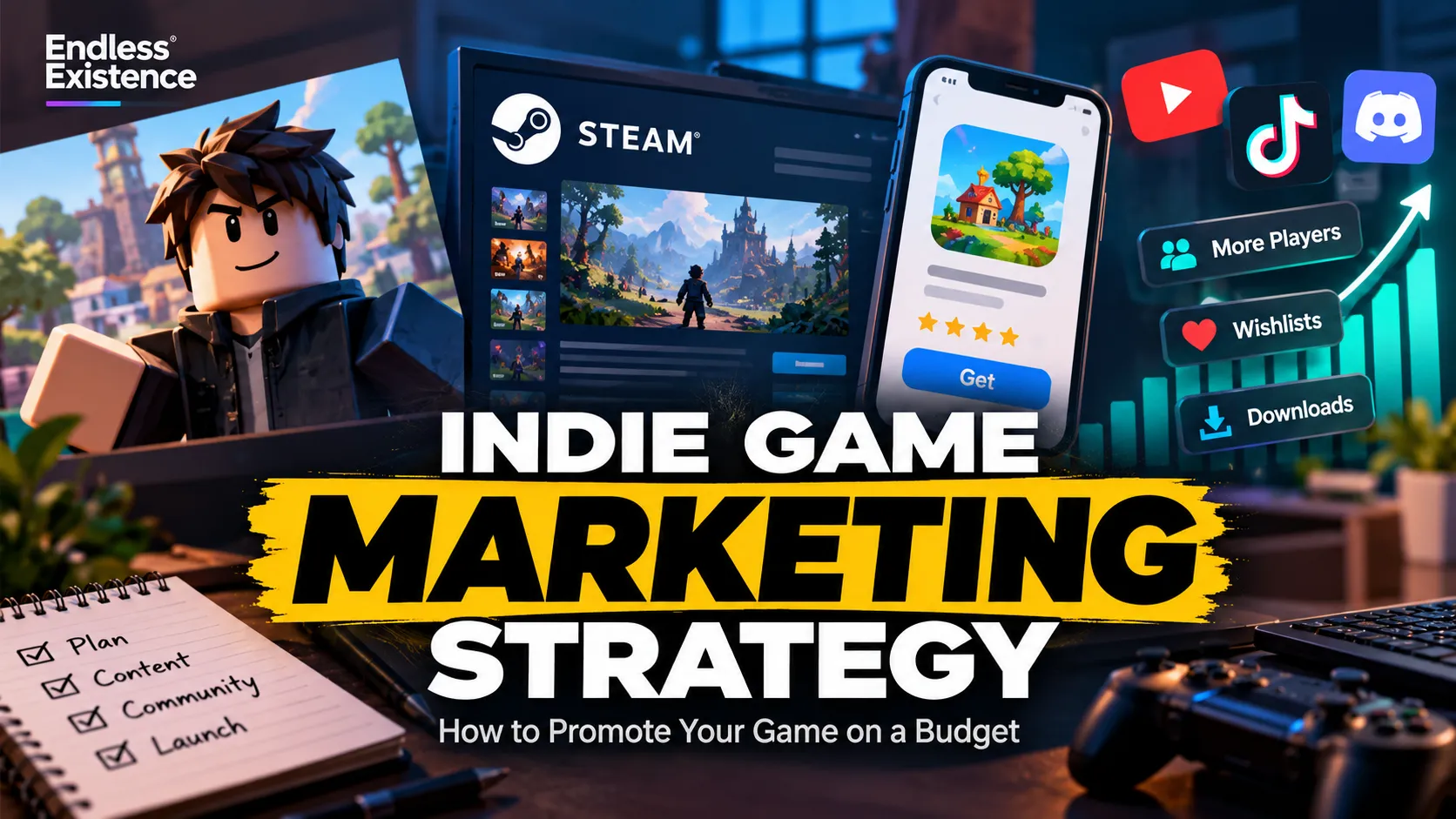
Building a game is only half the challenge of independent game development. The other half is getting people to discover it, understand why it is worth playing, and decide to give it a chance.
Many indie developers spend months or years creating a game before thinking seriously about marketing. They publish it, share a few screenshots on social media, and hope players will find it. When downloads, sales, or player counts remain low, they often assume the game needs more features or better graphics.
Sometimes it does. But the problem may be that the right audience has never heard about the game.
An effective indie game marketing strategy helps developers reach relevant players, communicate what makes their game interesting, and turn attention into measurable results. It does not necessarily require a large advertising budget, an established audience, or a dedicated marketing team.
In this guide, you will learn how to research your audience, position your game, use organic promotion, work with content creators, prepare for launch, measure marketing performance, and improve your results over time.
Whether you are developing a premium PC game, a Roblox experience, or a mobile game, the goal is to build a repeatable marketing process that fits your project and resources.
What Is an Indie Game Marketing Strategy?
An indie game marketing strategy is a plan for identifying potential players, communicating a game’s value, reaching the right audiences, and encouraging people to discover, play, purchase, or recommend it.
It combines several activities:
- Market and competitor research
- Audience identification
- Game positioning and branding
- Social media and content marketing
- Community building
- Influencer and streamer outreach
- Store page optimization
- Paid advertising
- Launch planning
- Performance measurement and optimization
These activities work together. A good promotional video cannot compensate for a confusing store page, and a successful advertising campaign cannot guarantee long-term growth if players quickly abandon the game.
The objective is not simply to generate attention. It is to attract people who are likely to enjoy the experience and give them a clear path from discovery to playing.
1. Start Marketing Before Your Game Is Finished
One of the most common indie marketing mistakes is waiting until launch to begin promotion.
By that point, the developer may have invested heavily in a concept without knowing whether potential players understand it, find it appealing, or would choose it over similar games.
Starting earlier creates opportunities to test assumptions while changes are still relatively inexpensive.
Research your target audience
Begin by answering a few questions:
- Who is most likely to enjoy this game?
- Which genres do these players already enjoy?
- What do they find frustrating or missing in similar games?
- Where do they discover new games?
- What would convince them to try yours?
Avoid defining your audience too broadly. “People who play video games” is not a useful marketing segment.
For example, an atmospheric puzzle game might appeal to players who enjoy environmental storytelling, exploration, and challenging puzzles. A chaotic multiplayer party game might appeal to groups looking for funny, unpredictable moments to share with friends.
These audiences may use different platforms, respond to different promotional messages, and expect different gameplay experiences.
Research competing games
Find five to ten games that share some combination of your genre, audience, mechanics, visual style, or distribution platform.
Study their store pages, trailers, screenshots, community discussions, and player reviews.
Pay particular attention to:
- How they explain their core gameplay.
- Which features appear repeatedly in their promotional materials.
- What players praise most frequently.
- What players complain about.
- Which screenshots and videos communicate the game most clearly.
- How they describe their differences from competing titles.
Reviews can be particularly useful because they reveal how players describe their experiences in their own words.
For example, if players repeatedly complain that a puzzle game has repetitive levels, your game might differentiate itself through procedural variation or more meaningful puzzle interactions—provided those features genuinely exist.
Do not copy another game’s marketing. Use competitor research to understand player expectations and identify opportunities to communicate your own game’s strengths.
Test your game’s appeal early
You do not need a finished product to start learning what attracts attention.
Create a short gameplay clip, prototype, or simple landing page that communicates the central idea. Show it to people who resemble your intended audience and ask what they think the game involves, what interests them, and what remains unclear.
Watch their reactions rather than relying exclusively on compliments.
If people cannot explain what makes your game interesting after seeing a short clip, your presentation may need improvement.
2. Develop a Clear and Distinctive Game Hook
Your game’s hook is the central idea that makes someone curious enough to investigate further.
It might be an unusual mechanic, an interesting combination of genres, a distinctive art style, an unexpected challenge, or a memorable social experience.
A useful hook answers this question:
Why should someone play this game instead of another game they could choose?
Consider these hypothetical examples:
- Generic: “A survival game with crafting and exploration.”
- More distinctive: “Explore a frozen world where every shelter you build changes the environment around it.”
- Generic: “A multiplayer cleaning simulator.”
- More distinctive: “Restore increasingly disgusting locations while racing against friends to clean the biggest messes.”
The second versions give potential players a more concrete reason to become interested.
Your hook should be easy to understand, specific enough to distinguish the game, and supported by actual gameplay.
Turn the hook into a marketing message
Once you identify the strongest aspect of your game, use it consistently across your store page, trailer, social profiles, and promotional videos.
You do not need identical wording everywhere. You need a consistent promise.
For example, if the appeal of your game is transforming filthy environments into spotless spaces, your marketing should demonstrate that transformation rather than relying primarily on development screenshots or lists of features.
A good hook also makes content creation easier. It gives you a repeatable subject for videos, GIFs, screenshots, community posts, and creator outreach.
3. Choose the Right Marketing Channels
Indie developers often spread themselves across too many platforms. They create accounts everywhere, publish occasionally, and struggle to maintain a consistent presence.
A better approach is to select a small number of channels that match your audience and your available time.
| Channel | Best use | Main limitation |
|---|---|---|
| YouTube Shorts | Demonstrating gameplay and memorable moments | Views do not guarantee players |
| TikTok | Testing short, attention-grabbing concepts | Results can be inconsistent |
| Reaching relevant niche communities | Self-promotion rules vary | |
| YouTube long-form | Tutorials, devlogs, and deeper demonstrations | Requires more production effort |
| Discord | Playtesting and community engagement | Difficult to grow without an existing audience |
| Steam | Reaching PC players and converting interest into wishlists or purchases | Strong competition |
| itch.io | Sharing experimental games, prototypes, and game jam projects | Discovery and conversion vary |
| Roblox | Acquiring players for interactive experiences | Engagement and retention matter alongside acquisition |
These channels serve different purposes. You should not expect every platform to produce the same outcome.
For example, a short video may introduce someone to your game, while a Steam page helps them evaluate it. A Discord community may help existing players stay engaged, while Roblox’s discovery system helps relevant users find experiences to play.
Start with one or two channels, learn what works, and expand when you have a repeatable process.
4. Use Short-Form Videos to Demonstrate Gameplay
Short-form video is a useful format for indie games because gameplay can often communicate the experience more effectively than a written description.
However, posting random clips is not a complete marketing strategy. Every video should demonstrate something that could make the intended audience interested.
Gameplay content worth testing
Unexpected moments: Show surprising mechanics, unusual interactions, or situations that produce an interesting outcome.
Satisfying gameplay: Demonstrate a transformation, a successful combination, a precise action, or a visually rewarding result.
Challenges and failures: Show a difficult obstacle, a funny mistake, or a situation that viewers can understand immediately.
Before-and-after comparisons: Present the difference between an untouched environment and a completed level, or between an early prototype and a later version.
Unique mechanics: Explain one interesting mechanic through gameplay rather than a long voice-over.
Player reactions: When available and used with permission, show genuine reactions that communicate the experience.
Structure a gameplay video
A simple structure is often sufficient:
- Opening: Present an interesting visual or situation immediately.
- Demonstration: Show the mechanic, challenge, or transformation.
- Payoff: Deliver the result that makes the clip satisfying or surprising.
- Call to action: Invite interested viewers to try the demo, wishlist the game, or visit the game page when appropriate.
The opening does not need exaggerated clickbait. It needs to make the content understandable and interesting quickly.
For example, a cleaning simulator could open with a room covered in trash, show the player using a powerful cleaning tool, and end with a dramatic transformation.
The viewer understands the premise without needing a lengthy explanation.
Test different hooks
Create several videos using the same gameplay footage but different openings.
One version might emphasize the satisfying transformation. Another might emphasize the difficulty. A third might focus on a funny interaction.
Compare their performance using the metrics available on each platform, including watch time, completion rate, profile visits, link clicks, and attributable game activity.
Do not judge success by views alone. A video with fewer views may attract a more relevant audience.
There is no universal posting frequency or video length that guarantees results. Begin with a sustainable schedule, measure the outcomes, and adjust based on evidence.
5. Build a Community Around the Game
A community can help an indie game gain early feedback, maintain interest during development, and encourage players to return after launch.
However, creating a Discord server or social media group does not automatically produce an active community.
Players need a reason to participate.
Useful reasons include:
- Access to playtests and early builds.
- Opportunities to suggest or discuss features.
- Regular development updates.
- Community challenges or competitions.
- Behind-the-scenes explanations of interesting mechanics.
- Bug reporting and feedback channels.
- Meaningful updates after release.
Choose the right community platform
Reddit can help developers participate in existing genre communities. Discord can support ongoing discussions with interested players. Social media can distribute updates to a broader audience.
For a small team, maintaining one active community is often more effective than managing several inactive ones.
If you use Reddit, read each community’s rules before sharing promotional material. Some communities permit development posts under specific conditions, while others restrict or prohibit direct advertising.
Participate genuinely. Answer questions, discuss relevant topics, and share useful development information rather than treating every community as an advertising channel.
Turn community feedback into better marketing
Players often describe a game’s appeal more clearly than its developers do.
If playtesters repeatedly mention that the game is relaxing, competitive, chaotic, or surprisingly difficult, those reactions can help you understand which aspects deserve greater attention.
Feedback should inform your messaging, but it should not replace product judgment. A small group of enthusiastic players may not represent the entire target audience.
6. Work With Influencers and Content Creators
Content creators can introduce your game to people who already trust their recommendations or enjoy watching games in your genre.
A creator with a relatively small, relevant audience may be a better fit than a much larger creator whose viewers are unlikely to care about your game.
Find suitable creators
Look for creators who regularly cover:
- Games in your genre.
- Similar games or competing titles.
- New indie releases.
- Games with mechanics comparable to yours.
- Experiences that naturally fit their video format.
Evaluate recent content rather than relying only on subscriber counts.
Consider whether the creator’s audience matches your intended players, whether their viewers engage meaningfully, and whether your game would make an interesting video.
Prepare a simple outreach package
Before contacting creators, prepare:
- A concise game description.
- A trailer or short gameplay demonstration.
- Relevant screenshots.
- A store page or playable demo.
- A list of features that make the game distinctive.
- Clear instructions for accessing the game.
- Your contact information.
For premium PC games, a review key may be appropriate. For Roblox experiences, a direct game link and a clear explanation of the core gameplay may be more useful.
Write personalized outreach messages
Avoid sending identical, lengthy messages to hundreds of creators.
Explain why the game might interest that particular creator’s audience, provide a convenient way to experience it, and make clear that coverage is entirely their choice.
Some creators may request payment, while others may independently decide to cover a game. Paid sponsorships should be budgeted separately from organic outreach, and applicable advertising disclosure requirements must be respected.
Most importantly, do not treat creator coverage as guaranteed. Outreach is an experiment, and the results will vary.
7. Optimize Your Game’s Store Page
Your store page is often where potential players decide whether your game deserves further attention.
It should quickly communicate what the game is, what players do, and why the experience is interesting.
Improve the first impression
Pay attention to these elements:
Game title and branding: Make the game’s identity recognizable and appropriate for its genre.
Icon or capsule image: Use clear imagery that remains understandable at smaller sizes.
Screenshots: Show real gameplay, important mechanics, distinctive environments, and meaningful variation.
Trailer: Demonstrate the actual experience early instead of delaying gameplay behind lengthy introductions or logos.
Description: Explain the central gameplay loop, important features, and distinctive appeal in readable language.
Tags and categories: Select accurate descriptors that help appropriate players discover the game.
Call to action: Make it clear whether visitors can wishlist, purchase, download, or play.
Avoid promising features that are not implemented or showing promotional footage that misrepresents the actual game.
Steam marketing strategy
For premium PC games distributed through Steam, an early store page can help capture interest before release.
Steam wishlists allow interested players to save a game and receive certain notifications, including relevant release and discount notifications. However, wishlist totals alone should not be treated as a guarantee of purchases or as a universal ranking advantage.
A useful Steam strategy includes:
- Creating a store page when you have enough accurate material to represent the game.
- Preparing clear screenshots and a gameplay-focused trailer.
- Choosing relevant tags and categories.
- Publishing development updates when there is something meaningful to share.
- Testing a demo when the game is ready.
- Contacting relevant creators.
- Investigating suitable events, including Steam Next Fest for eligible upcoming games.
- Tracking store traffic, wishlist growth, demo activity, and purchases.
A demo is especially valuable when the gameplay is difficult to communicate through screenshots alone. It gives interested players an opportunity to experience the game before purchasing.
For the latest requirements and platform-specific details, consult the official Steamworks documentation.
Roblox game marketing strategy
Roblox games require a different approach because the experience is commonly free to access, and the developer’s objectives may include repeat play, engagement, social interaction, and in-experience spending.
Important considerations include:
- Creating an icon and thumbnail that accurately communicate the experience.
- Making the first few minutes understandable and rewarding.
- Reducing unnecessary friction during onboarding.
- Providing meaningful progression.
- Giving players reasons to return.
- Supporting enjoyable interactions with friends.
- Monitoring acquisition and engagement metrics.
- Testing promotional campaigns against player quality, not just traffic volume.
For example, a cleaning simulator could use a thumbnail showing a dramatic before-and-after transformation. But if new players enter the game and cannot understand how to pick up trash or complete their first task, the thumbnail will not solve the underlying problem.
Roblox discovery systems use multiple signals, including aspects of player engagement and retention. Developers should consult current official documentation rather than relying on simplistic claims about how the recommendation system works.
Start with the Roblox Creator Hub for discovery guidance.
Mobile game marketing strategy
Mobile games often require close attention to acquisition costs, store conversion, onboarding, and player retention.
Useful activities include:
- Testing app icons and screenshots.
- Demonstrating gameplay through short video ads.
- Improving the store listing.
- Measuring installs and first-session completion.
- Tracking day-one and day-seven retention.
- Evaluating monetization and acquisition costs.
- Using appropriate attribution tools.
Mobile advertising can generate substantial traffic without generating a sustainable business. If players install the game but leave quickly, improving the onboarding experience may be more valuable than increasing advertising expenditure.
8. Use Paid Advertising Carefully
Paid advertising can help developers test promotional messages and reach potential players beyond their existing audience.
However, spending money before understanding the game’s appeal can waste a limited budget.
Treat advertising as a controlled experiment rather than a shortcut to popularity.
Start with a clear hypothesis
For example:
“Our cleaning simulator’s transformation-based creative will attract more engaged players than a creative focused on tool upgrades.”
This hypothesis can be tested by running comparable creative experiments while keeping other variables as consistent as practical.
Depending on the platform and campaign objective, useful measurements may include impressions, clicks, cost per click, installs, first plays, retention, and attributed revenue.
Understand the difference between cheap traffic and valuable players
Suppose Campaign A generates inexpensive clicks, but most visitors leave immediately.
Campaign B generates fewer clicks at a higher cost, but its players complete the tutorial and return the next day.
Campaign B may provide better long-term value, depending on the game’s business model and acquisition costs.
This is why marketing performance should be evaluated beyond the initial click or install.
Calculate the economics
For a game that earns revenue, a simplified return on advertising spend calculation is:
ROAS = Attributed revenue ÷ Advertising spend
For example, if a campaign generates $200 in attributed revenue from $100 in advertising expenditure, its reported ROAS is 2.0, or 200%.
That does not necessarily mean the campaign is profitable. Revenue is not the same as profit, and the calculation may exclude platform fees, refunds, development costs, taxes, and other expenses.
For a free-to-play game, the analysis may also require longer observation periods because some players generate value over multiple sessions.
For a premium game, distinguish gross sales revenue from the developer’s actual proceeds.
If you cannot yet measure whether advertising produces useful outcomes, begin with small experiments and establish reliable tracking before scaling.
9. Build a Practical Content Marketing System
Consistency is useful only when it is sustainable and produces content worth consuming.
Instead of inventing a completely new promotional idea every day, develop a repeatable set of content categories.
For example:
| Content category | Example |
|---|---|
| Gameplay demonstrations | Show a unique mechanic |
| Development progress | Explain a meaningful improvement |
| Challenges | Present a difficult or unusual situation |
| Before and after | Compare an early prototype with the current build |
| Community feedback | Explain how a player suggestion influenced development |
| Tutorials | Teach something relevant to your game’s audience |
| Announcements | Share demo releases, updates, and launch dates |
A single development session can generate multiple useful assets.
A new gameplay mechanic might become a short video, a GIF, a development update, and a longer explanation. Each asset should be adapted to its intended audience rather than reposted without thought.
Separate developer content from player-focused content
This distinction is particularly important.
Other developers may enjoy watching you solve a technical problem, discuss architecture, or explain a shader implementation. Potential players may be more interested in what the mechanic allows them to do.
Both audiences can be valuable, but they have different motivations.
If your primary objective is to acquire players, make sure your content regularly demonstrates why playing the game is interesting.
10. Measure the Metrics That Matter
Without measurement, it is difficult to determine whether a marketing campaign is improving.
You do not need a complex analytics system at the beginning. Start with a small set of metrics connected to your current objective.
Core marketing metrics
| Metric | What it measures |
|---|---|
| Click-through rate (CTR) | The proportion of impressions that produce clicks |
| Cost per click (CPC) | Advertising spend divided by clicks |
| Cost per install (CPI) | Advertising spend divided by attributed installs |
| Cost per first play | Advertising spend divided by attributed first plays |
| Wishlist growth | Net additions to a game’s wishlist over a period |
| Conversion rate | The proportion of eligible visitors who complete a defined action |
| Day-one retention | The proportion of an eligible player cohort returning on the next day |
| Day-seven retention | The proportion of an eligible player cohort returning on day seven |
| Customer acquisition cost (CAC) | Acquisition expenditure divided by acquired customers |
| Return on ad spend (ROAS) | Attributed revenue divided by advertising expenditure |
Use consistent definitions and time windows when comparing results. Retention, attribution, and conversion may be calculated differently by different platforms.
Diagnose the funnel
Suppose a short video generates many views but few store-page visits.
Possible explanations include a weak call to action, an audience that is interested in the clip but not the game, or an unclear connection between the video and the game page.
If the store page attracts visitors but few people wishlist or purchase, investigate the presentation, price, screenshots, trailer, and audience fit.
If a Roblox campaign attracts new players but they leave quickly, examine the opening experience, performance, tutorial, difficulty, and the time required to reach the first meaningful reward.
The purpose of measurement is not to blame a particular channel. It is to identify the weakest part of the process and test an improvement.
11. Create a 90-Day Indie Game Marketing Plan
The following framework provides a manageable starting point for developers who have limited time and resources.
Days 1–30: Research and positioning
Primary objective: Understand the audience and communicate the game’s appeal.
Actions:
- Identify five to ten comparable games.
- Study reviews and player discussions.
- Define the primary audience.
- Write a clear description of the game’s central hook.
- Produce initial gameplay clips.
- Test the concept with relevant players.
- Choose one or two marketing channels.
- Establish baseline metrics.
Expected outcome: A clearer positioning statement, an initial collection of promotional assets, and a better understanding of the audience.
Days 31–60: Build awareness and validate interest
Primary objective: Determine which messages and channels attract relevant players.
Actions:
- Publish gameplay-focused content consistently.
- Test different video openings and creative concepts.
- Participate in appropriate communities.
- Create or improve the game page.
- Invite relevant players to test the game.
- Begin personalized creator outreach.
- Collect feedback on the game’s presentation and opening experience.
- Review available engagement and conversion metrics.
Expected outcome: Evidence about which promotional messages attract interest and which parts of the experience need improvement.
Days 61–90: Optimize and prepare for launch
Primary objective: Concentrate resources on the approaches that show the most promise.
Actions:
- Improve the strongest-performing promotional assets.
- Refine the store page or game listing.
- Prepare a demo or launch build when appropriate.
- Coordinate creator outreach and announcements.
- Test modest paid campaigns if the budget and measurement system allow.
- Improve onboarding and retention.
- Prepare a launch checklist.
- Establish a post-launch update plan.
Expected outcome: A more coherent marketing process, improved promotional materials, and a better-informed launch strategy.
These stages are flexible. A developer working on an early prototype may need more time for validation, while a nearly finished game may need a shorter, more focused preparation period.
The important point is to learn before scaling.
12. Common Indie Game Marketing Mistakes
Waiting until launch
A release announcement cannot replace months of audience discovery and interest-building. Start testing the game’s appeal as early as you can communicate it accurately.
Promoting features instead of experiences
A list of crafting systems, weapons, levels, or upgrades does not automatically explain why the game is fun. Demonstrate what players actually do and why it matters.
Chasing viral views
A viral clip can create awareness without producing meaningful player acquisition. Measure downstream actions rather than assuming high reach means marketing success.
Targeting everyone
A broad audience is not always a useful audience. Focus your message on the players most likely to enjoy the game.
Ignoring the first session
Marketing may bring players into the game, but confusing onboarding or weak early gameplay can prevent them from staying.
Spending too early
Large advertising campaigns are difficult to justify before you understand your creative performance, conversion process, and player quality.
Abandoning marketing after launch
A release is not the end of the marketing process. Updates, creator coverage, community activities, improvements, and new content can create additional opportunities to reach players.
Copying another game’s success
A strategy that works for a well-known multiplayer game may not work for a niche single-player puzzle game. Use successful examples as inspiration, not as universal formulas.
13. Frequently Asked Questions
How much money does an indie game need for marketing?
There is no universal minimum budget. Developers can begin with competitor research, community participation, gameplay clips, and direct creator outreach without spending heavily on advertising.
The real constraint is often time, consistency, and the quality of the game presentation. Paid campaigns become more useful when the developer has a clear hypothesis, measurable objectives, and enough evidence to evaluate results.
Can an indie game succeed without paid advertising?
Yes. Organic discovery, community participation, creator coverage, searchable content, platform discovery, and word of mouth can all contribute to growth.
However, organic marketing is not free of cost. It requires time, experimentation, and sustained effort, and it does not guarantee visibility or sales.
When should I start marketing my indie game?
Start when you can communicate the concept accurately. Early development may be suitable for testing ideas, while a playable prototype allows you to demonstrate actual gameplay.
As the game matures, improve your store page, promotional materials, demo, and launch plan.
Which social media platform is best for indie game marketing?
There is no universally best platform. The appropriate choice depends on your audience, genre, content format, and objectives.
Short-form video platforms may be useful for visually understandable gameplay. YouTube can support both short demonstrations and deeper content. Reddit can help reach niche communities, while Discord can support ongoing engagement.
Test a small number of channels before expanding.
Are wishlists a guarantee of Steam sales?
No. Wishlists indicate interest, but not every person who wishlists a game will purchase it. Some sales may also come from players who never wishlisted.
Use wishlists as one indicator of demand and evaluate them alongside store traffic, demo engagement, purchases, and other available data.
How do I market a Roblox game with a small budget?
Begin by improving the game’s icon, thumbnail, core gameplay loop, onboarding, and retention. Publish clear gameplay demonstrations, participate in relevant communities, and measure the quality of acquired players.
If you use paid promotion, evaluate whether players complete meaningful actions and return, rather than judging the campaign only by its traffic volume.
How often should I post game marketing content?
Choose a schedule you can maintain without undermining development. Consistent, relevant content is generally more useful than a burst of low-quality posts followed by long periods of inactivity.
Experiment with different formats and frequencies, then use performance data and audience feedback to refine the schedule.
Conclusion
An effective indie game marketing strategy is not about posting everywhere, spending as much as possible, or hoping a single video becomes popular.
It is about understanding the audience, communicating a distinctive game experience, choosing suitable channels, and learning from measurable results.
Start by researching comparable games and identifying what makes yours worth playing. Demonstrate that appeal through real gameplay. Build relationships with relevant communities and creators. Improve your store page and first-session experience. Measure the results, and invest more effort in the approaches that attract the right players.
Most importantly, treat marketing as part of game development rather than a task reserved for launch week.
The goal is not simply to make more people see your game. It is to help the right people discover it, understand its value, and enjoy playing it.