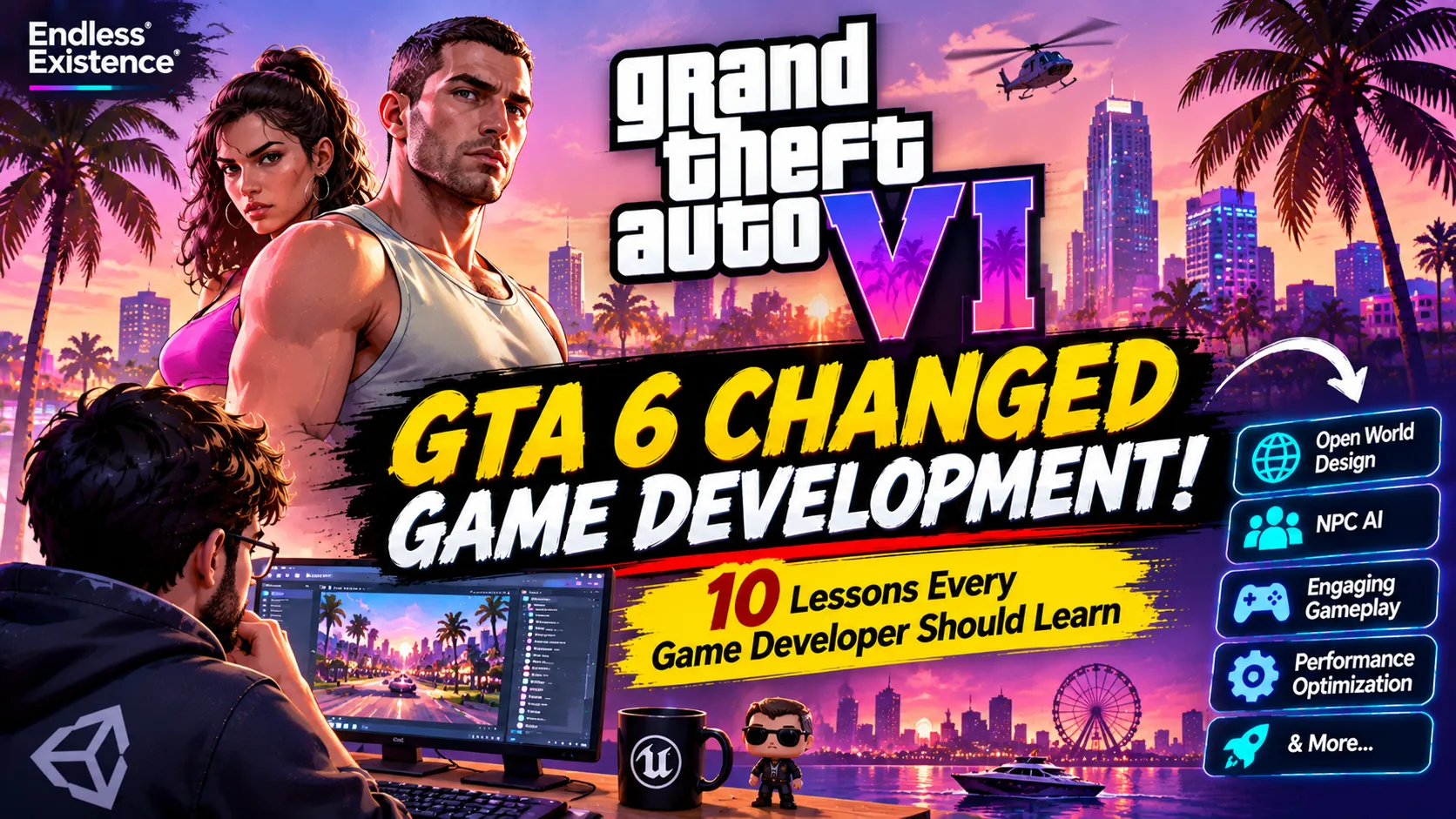
After more than a decade of anticipation, Grand Theft Auto VI has finally arrived.
Developed by Rockstar Games, GTA 6 launched worldwide on November 19, 2026, for PlayStation 5 and Xbox Series X|S. Set in the fictional state of Leonida, the game returns players to Vice City with two central protagonists, Jason and Lucia.
But GTA 6 is more than another major entertainment release.
It represents an important moment for the game development industry. Its enormous world, detailed characters, interconnected gameplay systems, environmental storytelling, and technical ambition offer valuable lessons for developers at every level.
You don’t need a billion-dollar budget or thousands of developers to learn from Rockstar.
Whether you’re developing games in Unity, Unreal Engine, Godot, or Roblox Studio, there are design principles behind GTA 6 that you can apply to your own projects.
Let’s explore 10 of the biggest game development lessons from GTA 6.
1. A Living World Is More Important Than a Huge Map
One of the biggest achievements of GTA 6 is the feeling that Leonida exists beyond the player’s immediate actions.
A successful open world isn’t simply a large environment filled with roads, buildings, and landmarks.
It needs activity.
People move around, vehicles travel through streets, conversations happen, businesses operate, and unexpected situations can emerge while players explore.
The Guardian’s review highlighted the enormous variety of activities and incidental encounters that make Leonida feel like a place rather than simply a backdrop for missions.
This reveals an important game design principle:
World density can matter more than world size.
Imagine two open-world games.
- Game A has a massive map with long stretches of empty terrain.
- Game B has a smaller map filled with meaningful interactions, interesting locations, and environmental events.
Even though Game A is larger, Game B may feel much more alive.
What developers can learn
You don’t need to build a massive open world.
Instead, focus on:
- Interesting locations
- Environmental interactions
- NPC activities
- Dynamic events
- Hidden discoveries
- Meaningful exploration rewards
For indie developers, a small but densely designed environment can create a much stronger experience than an enormous empty map.
2. Small Details Can Create Massive Immersion
GTA 6 demonstrates how seemingly minor interactions can contribute to a convincing virtual world.
Driving is not just about moving from one location to another. Vehicles have more interaction, interiors receive attention, and ordinary actions contribute to the overall experience.
Early player impressions highlighted details such as vehicle interactions, more involved police encounters, and environmental animation.
These details may not sound revolutionary individually, but together they make the world feel more believable.
Consider a simple example.
In a typical game, entering a vehicle might involve pressing one button and instantly appearing in the driver’s seat.
A more detailed interaction could include:
- Approaching the vehicle.
- Opening the door.
- Entering the vehicle.
- Starting the engine.
- Interacting with vehicle controls.
Not every game needs this level of simulation. The important question is whether the interaction supports the experience.
What developers can learn
Don’t add details simply to make a feature list longer.
Ask yourself:
- Does this interaction improve immersion?
- Does it make the gameplay more satisfying?
- Does it communicate something about the world?
- Does it create interesting player choices?
A small interaction can become memorable when it fits naturally into the gameplay.
3. NPC Behaviour Is a Major Part of Modern Game Design
NPCs are often treated as background decoration.
Developers create characters that stand in one place, repeat animations, or follow predetermined paths.
But convincing NPC behaviour can make an enormous difference to an open-world experience.
GTA 6’s world has received particular attention for its populated environments, spontaneous encounters, and characters who contribute to the feeling of everyday life.
A convincing NPC system can involve several layers:
Basic behaviour: Walking, standing, sitting, and interacting with objects.
Contextual behaviour: Reacting to weather, nearby events, vehicles, and other characters.
Social behaviour: Talking, arguing, gathering, and responding to social situations.
Reactive behaviour: Responding to the player’s actions and changes in the environment.
What developers can learn
You don’t need sophisticated AI for every NPC.
A useful approach is to create behaviour systems with different levels of complexity.
For example:
- Background NPCs use lightweight behaviour.
- Important NPCs have more complex routines.
- Mission characters use context-specific behaviour.
- Special characters react to important gameplay events.
This approach helps balance immersion and performance.
4. Gameplay Systems Should Work Together
One of the most important lessons from GTA 6 is the value of interconnected systems.
A game can contain dozens of impressive features, but if those features operate independently, the experience may feel disconnected.
A stronger design allows different systems to influence one another.
Consider how a character system might connect:
Character Stats → Physical Activities → Health and Stamina → Gameplay Performance
Or how a world system might connect:
Weather → Road Conditions → Vehicle Handling → Police Chase Difficulty
These relationships create depth.
TechRadar’s review specifically highlighted the way character progression, everyday activities, phone interactions, and mission mechanics connect to the broader experience.
What developers can learn
When designing a game, think beyond individual features.
Ask:
- How does this mechanic interact with other systems?
- Can player decisions affect multiple parts of the game?
- Can environmental conditions change gameplay?
- Do progression systems influence how players approach missions?
A small number of interconnected systems can create more depth than dozens of unrelated mechanics.
5. Animation Is Not Just Visual Polish
Animation is one of the most important parts of making a game feel believable.
Players notice when characters move unnaturally, react too slowly, or transition awkwardly between actions.
GTA 6 has received strong attention for its animation quality, character performances, and attention to physical detail.
But animation is not only about visual realism.
It communicates information.
For example:
- A character’s posture can communicate fear.
- An animation transition can indicate injury.
- A reaction can communicate surprise.
- Movement can communicate personality.
- Body language can make dialogue more believable.
What developers can learn
Even a stylized indie game benefits from good animation.
Focus on:
- Responsive movement.
- Natural transitions.
- Clear interaction feedback.
- Appropriate reaction animations.
- Consistent character movement.
In many games, responsive and readable animation is more important than photorealistic character models.
6. Environmental Storytelling Makes Exploration Meaningful
Traditional storytelling often depends on dialogue, cutscenes, and written information.
Environmental storytelling offers another approach.
Instead of explaining everything directly, the environment communicates information through its design.
A damaged building can suggest a past event.
An abandoned vehicle can create curiosity.
A character’s belongings can reveal personality.
A location’s condition can tell a story without a single line of dialogue.
GTA 6’s detailed world and its many locations provide a strong example of how exploration can contribute to the overall narrative experience.
What developers can learn
Try telling small stories through:
- Environmental objects
- Lighting and composition
- Character placement
- Visual changes
- Audio clues
- Interactive discoveries
This technique is particularly useful for indie developers because environmental storytelling can create depth without requiring extensive dialogue or expensive cinematic sequences.
7. Audio Design Can Make a Virtual World Feel Real
Graphics usually receive the most attention in discussions about modern games.
But sound design is equally important.
A believable environment needs an audio identity.
Think about the different sounds in a city:
- Distant traffic
- Conversations
- Emergency sirens
- Construction work
- Footsteps
- Weather
- Vehicle engines
- Background music
These sounds help players understand where they are and what is happening around them.
GTA 6 also uses music and radio as important parts of its world identity. The soundtrack, environmental audio, and cultural atmosphere help establish the personality of Leonida.
What developers can learn
Use audio to communicate information, not simply to fill silence.
For example:
- Different surfaces should produce different footsteps.
- Important interactions should have clear audio feedback.
- Distant sounds can suggest activity beyond the player’s view.
- Music can reinforce the emotional tone of a location.
- Environmental audio can make otherwise simple environments feel alive.
Good audio design can make a relatively small game world feel significantly richer.
8. Technical Ambition Must Be Balanced With Performance
GTA 6 is an example of a game designed around current-generation console hardware.
Its official launch platforms are PlayStation 5 and Xbox Series X|S. Rockstar has not announced an official PC release date on its launch announcement.
The game’s visual presentation, detailed environments, animation systems, and large-scale world simulation require substantial technical resources.
However, impressive visuals are only part of the challenge.
Developers must also consider:
- CPU performance
- GPU performance
- Memory usage
- Asset streaming
- Animation processing
- Physics simulation
- AI update frequency
- Loading times
Reviews have praised GTA 6’s technical presentation while also noting its 30 FPS target on console.
This highlights an important point: visual quality and performance are separate engineering goals that must be balanced.
What developers can learn
If you’re building a large environment in Unity or Unreal Engine, consider:
Level of Detail (LOD): Use simpler models when objects are far away.
Occlusion Culling: Avoid rendering objects that cannot be seen.
Asset Streaming: Load resources based on player location and gameplay requirements.
AI Optimization: Avoid updating every NPC with expensive logic every frame.
Profiling: Measure actual performance before attempting optimization.
The best optimization strategy is based on evidence, not assumptions.
9. Long Development Cycles Don’t Guarantee Success
GTA 6 demonstrates the scale of ambition possible in modern AAA production.
However, its development timeline should not be treated as a blueprint for every studio.
Rockstar has the resources, experience, infrastructure, and production capacity of an established global game company.
A small indie team cannot simply copy its production model.
Instead, developers should study the principles behind the game and adapt them to their own limitations.
For example:
| AAA production approach | Indie-friendly alternative |
|---|---|
| Huge open world | Small, dense environment |
| Thousands of NPCs | Fewer, more meaningful NPCs |
| Complex simulation | Focused interconnected systems |
| Extensive cinematic animation | Strong gameplay animation |
| Large content pipeline | Modular reusable content |
| Massive testing operation | Automated and focused testing |
The lesson is not to make every game bigger.
It is to make every development decision count.
10. Player Expectations Are Changing
Perhaps the biggest lesson from GTA 6 is that players increasingly expect more than impressive graphics.
They want worlds that feel alive, characters they care about, meaningful activities, responsive controls, and experiences that reward exploration.
This creates opportunities and challenges for developers.
Players can now compare games across genres, platforms, and production budgets. A smaller game may not compete with Rockstar in visual scale, but it can compete through creativity, gameplay, atmosphere, and originality.
The industry does not need thousands of copies of GTA.
It needs different experiences that learn from what makes great games engaging.
What developers can learn
Focus on the experience your game promises.
If your game is about survival, make survival interesting.
If your game is about cooperation, make teamwork meaningful.
If your game is about exploration, make discovery rewarding.
A strong identity is more valuable than copying a competitor’s feature list.
What GTA 6 Means for the Future of Game Development
GTA 6 is likely to influence how developers think about open-world design, immersive environments, character interactions, and production quality.
Its launch also creates an opportunity to study the relationship between technical complexity and player experience.
Some particularly interesting areas to watch include:
- More sophisticated NPC behaviour
- Better environmental simulation
- More interconnected gameplay systems
- Advanced character animation
- Improved audio implementation
- More detailed open-world interactions
- Better performance and streaming techniques
These ideas are not exclusive to AAA studios.
Unity, Unreal Engine, and Godot developers can experiment with many of these principles on a much smaller scale.
The important thing is to understand the design problem before choosing the technology.
Final Thoughts: Don’t Build Another GTA. Learn From It.
GTA 6 is an extraordinary example of large-scale game development, but its most valuable lessons are not about building the biggest map or the most realistic graphics.
They are about creating a world where systems, characters, environments, animation, audio, and gameplay work together.
A small indie developer can apply those principles to a compact survival game.
A Unity developer can experiment with more reactive NPCs.
An Unreal developer can explore environmental storytelling.
A Roblox developer can build more interactive multiplayer environments.
You don’t need Rockstar’s budget to learn from Rockstar’s design philosophy.
The next great game doesn’t have to be bigger than GTA 6. It has to give players a reason to remember it.
Frequently Asked Questions
When did GTA 6 release?
Grand Theft Auto VI launched on November 19, 2026, for PlayStation 5 and Xbox Series X|S.
Is GTA 6 available on PC?
Rockstar’s official launch announcement lists PlayStation 5 and Xbox Series X|S. No official PC release date has been announced.
Which game engine does GTA 6 use?
Rockstar has not publicly confirmed a different engine for GTA 6. The studio is known for developing its proprietary Rockstar Advanced Game Engine (RAGE). It is not a game built with Unity or Unreal Engine.
What can indie developers learn from GTA 6?
Indie developers can learn about world density, environmental storytelling, NPC behaviour, interconnected gameplay systems, animation, audio design, and performance optimization.
Why is GTA 6 important for the game development industry?
Its scale and design provide a high-profile example of how technology, world-building, and gameplay systems can work together to create an immersive experience. It also gives developers an opportunity to study modern AAA production choices.
Can Unity developers create GTA-style open-world games?
Yes. Unity supports large environments, vehicle systems, AI, physics, and open-world gameplay. However, achieving the same production scale and fidelity requires significant engineering, content, and optimization work.
Is GTA 6’s world completely simulated?
Not every detail in a game world needs to be simulated continuously. Games commonly combine scripted events, reactive systems, ambient behaviours, and optimized simulations. Rockstar has not published a complete technical breakdown of GTA 6’s world simulation.
Research sources
- Rockstar Games — GTA VI Now Available — official launch announcement, date, and platforms. Rockstar Games
- The Guardian — Grand Theft Auto VI Review — world design, environmental detail, activities, and immersion. The Guardian
- TechRadar — GTA 6 Review — interconnected gameplay systems, NPCs, character progression, animation, and audio. TechRadar
- The Outerhaven — GTA 6 Review — technical presentation, world systems, and performance observations. Surpassing All Expectations
- Rockstar Games — GTA VI Official Website — official game information, trailers, and media.