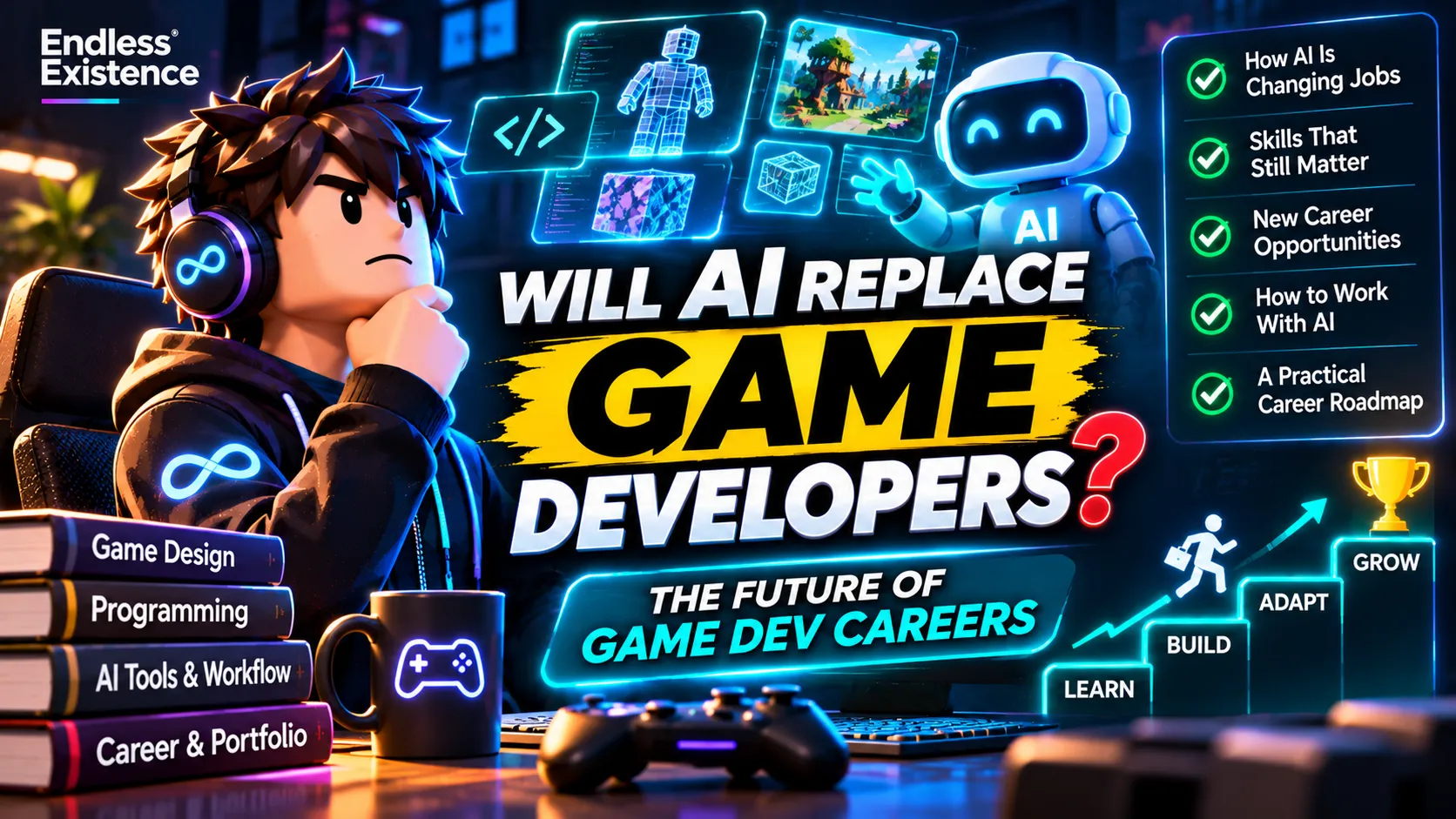
Will AI replace game developers? Discover how artificial intelligence is changing game development careers, which skills will matter most, and how aspiring and professional developers can adapt to the new industry.
Artificial intelligence is changing the way games are designed, programmed, tested, and produced.
Today, a developer can use an AI coding agent to implement a gameplay system, generate a prototype, investigate bugs, or automate repetitive tasks. Artists can explore visual concepts faster, designers can experiment with gameplay ideas, and small teams can accomplish work that previously required more people.
This creates an important question for anyone considering a career in game development:
If AI can generate code, art, animations, and even playable prototypes, what will happen to human game developers?
Some developers see AI as an opportunity to become more productive. Others worry about job security, creative ownership, fewer entry-level positions, and the possibility that studios will replace parts of their workforce with automated systems.
Both perspectives deserve attention.
The reality is that game development is not simply disappearing because of AI. However, the skills that make someone valuable as a game developer are changing.
In this guide, we will explore the future of game development careers, the impact of AI on different roles, and practical ways to remain competitive in an increasingly AI-assisted industry.
1. The Current State of the Game Development Job Market
Before discussing how to build a career, it is important to understand what is happening in the industry.
The game development job market has faced significant pressure over recent years. Studio restructuring, project cancellations, changing investment priorities, and layoffs have affected developers across multiple disciplines.
The 2026 State of the Game Industry report, published by the Game Developers Conference (GDC), provides some useful insights.
Based on responses from more than 2,300 game industry professionals:
- 28% of respondents said they had been laid off within the previous two years.
- 50% said their current or most recent employer had conducted layoffs within the previous 12 months.
- 74% of surveyed students expressed concern about their future job prospects in the game industry.
- 36% of respondents said they used generative AI tools as part of their work.
- 52% believed generative AI was having a negative impact on the game industry.
These numbers highlight two simultaneous challenges: an uncertain employment environment and growing concerns about AI.
However, it would be misleading to conclude that AI alone caused the industry’s layoffs. The report identifies a wider range of industry pressures, and layoffs have multiple causes.
The same report also shows that game development remains a multidisciplinary profession. Its respondents included game designers, programmers, visual and technical artists, producers, business professionals, and other specialists.
The important lesson: Becoming a game developer is still a realistic career goal, but entering the industry requires more preparation, stronger practical skills, and a better understanding of how modern studios work.
Source: GDC — 2026 State of the Game Industry
2. Will AI Replace Game Developers?
This is probably the biggest question among aspiring developers.
AI can already perform tasks that previously required human developers:
- Generate scripts and functions.
- Create simple 3D models.
- Produce concept art.
- Generate dialogue and narrative drafts.
- Assist with animation workflows.
- Write test cases.
- Investigate programming errors.
- Create basic gameplay prototypes.
If AI can do all these things, why would a studio hire a developer?
The answer is that completing individual tasks is not the same as developing a successful game.
A commercial game involves hundreds of interconnected decisions.
Someone must understand the intended player experience, design the underlying systems, choose appropriate technical solutions, manage performance, maintain consistency, and determine whether the final product is actually enjoyable.
AI can assist with these responsibilities, but it does not automatically understand the creative and technical context of an entire production.
Consider a simple example.
An AI coding agent might generate a working inventory system. But a professional developer still needs to determine:
- How inventory data should be structured.
- How items interact with other gameplay systems.
- How inventory changes are saved.
- What happens when network requests fail.
- How the UI handles hundreds of items.
- How the system performs on low-end devices.
- How the feature fits into the overall game architecture.
Generating code is only one part of solving the problem.
The more realistic future
Instead of imagining that AI will replace every developer, consider a more likely change:
Developers who understand their craft and use AI effectively may become more productive than developers who rely entirely on traditional workflows.
This does not guarantee that studios will hire more people. Greater productivity can also mean smaller teams, different hiring priorities, and fewer opportunities for some routine tasks.
That is why adapting your skills matters.
3. Which Game Development Careers Are Most Affected by AI?
AI will not affect every game development role in the same way.
Some responsibilities are easier to automate, while others require deeper technical understanding, creative judgment, or collaboration.
Let’s examine the major career paths.
Game Programmer / Gameplay Programmer
<underline>AI impact: High task automation, but strong opportunities for skilled engineers.</underline>
AI coding tools can generate boilerplate code, implement common functions, explain APIs, and assist with debugging.
This changes the value of basic coding work.
A developer who only knows how to write simple scripts may face more competition from AI-assisted developers.
However, experienced programmers provide much more than code generation.
Important skills include:
- Data structures and algorithms.
- Object-oriented programming.
- Game architecture.
- Performance optimization.
- Memory management.
- Multiplayer networking.
- Debugging and profiling.
- Software design patterns.
For Unity developers, C# and engine architecture remain valuable.
For Unreal developers, C++, Blueprints, gameplay architecture, and performance profiling remain important.
For Roblox developers, Luau, networking, client-server architecture, DataStores, and scalable game systems are essential.
Career advice: Do not compete with AI at generating basic scripts. Become the developer who understands, integrates, optimizes, and maintains complex systems.
Game Designer
<underline>AI impact: Moderate to high assistance, with human creative direction remaining important.</underline>
AI can generate game ideas, quests, item descriptions, level concepts, and initial balancing suggestions.
However, creating an enjoyable gameplay experience requires experimentation and judgment.
A game designer must understand:
- Gameplay loops.
- Player motivation.
- Progression systems.
- Difficulty curves.
- Game economy.
- Level design.
- Player psychology.
- Retention and engagement.
AI can suggest ten different progression systems, but it cannot guarantee that any of them will make the game enjoyable.
Career advice: Learn to prototype and evaluate gameplay systems. Build an understanding of player behavior rather than relying only on AI-generated design documents.
3D Artist and Technical Artist
<underline>AI impact: Significant changes to asset-production workflows.</underline>
AI-generated images and 3D models are becoming increasingly useful for concept development and rapid prototyping.
Tools can help generate visual references, textures, and initial 3D assets.
However, production-ready assets still require technical preparation.
A professional 3D artist should understand:
- Modeling and topology.
- UV mapping.
- PBR materials.
- Rigging and animation.
- LOD generation.
- Texture optimization.
- Real-time rendering.
- Engine-specific asset pipelines.
Technical artists may be particularly valuable because they understand both visual production and the technical requirements of game engines.
Career advice: Learn how to turn rough AI-generated assets into optimized, consistent, production-ready game content.
Game Animator
<underline>AI impact: Increasing automation of selected animation tasks.</underline>
AI can assist with motion generation, animation cleanup, retargeting, and procedural animation workflows.
However, animation is not simply about moving a character from one position to another.
Professional animators need to understand:
- Timing and spacing.
- Weight and anticipation.
- Character performance.
- Motion readability.
- Animation blending.
- Rigging.
- Gameplay responsiveness.
Career advice: Develop strong animation fundamentals and learn how to integrate animations into real-time gameplay systems.
QA Tester / Game Tester
<underline>AI impact: Significant changes to repetitive testing workflows.</underline>
Automated testing, bots, and AI-assisted bug investigation can reduce the need for some repetitive manual testing tasks.
However, testing a game involves more than checking whether a function works.
Human testers can identify:
- Confusing gameplay.
- Poor player feedback.
- Frustrating difficulty.
- Unexpected player behavior.
- Visual inconsistencies.
- Accessibility problems.
- Issues that automated systems do not recognize.
Career advice: Develop skills in test automation, bug reporting, gameplay analysis, and quality assurance engineering.
Technical Artist and Tools Programmer
<underline>AI impact: Strong opportunity for developers who bridge creative and technical work.</underline>
Technical artists and tools programmers help production teams work more efficiently.
They build tools, automate pipelines, improve asset workflows, create shaders, and solve problems between art and engineering.
AI can help them write tools faster, but understanding the production pipeline remains essential.
This is a particularly interesting career direction for developers who enjoy both programming and visual production.
4. The Most Important Skills Game Developers Should Learn in 2026
If AI is changing how games are made, what should developers focus on learning?
The answer is not simply learning more AI tools.
A sustainable career requires a combination of technical fundamentals, production experience, creative problem-solving, and AI literacy.
Here are seven areas worth prioritizing.
1. Programming Fundamentals
Even if AI writes a large portion of your code, you need to understand what that code does.
Learn:
- Variables and data types.
- Functions and classes.
- Object-oriented programming.
- Data structures.
- Algorithms.
- Memory and performance.
- Debugging.
- Software architecture.
Do not skip programming fundamentals because an AI tool can generate code.
If you cannot understand the generated solution, you cannot reliably maintain it.
2. Game Engine Expertise
Choose one primary engine and develop a strong understanding of it.
Useful choices include:
- Unity for cross-platform and mobile development.
- Unreal Engine for advanced 3D production.
- Godot for open-source and independent development.
- Roblox Studio for the Roblox ecosystem.
Understanding an engine deeply is more valuable than knowing the basics of five different engines.
3. AI-Assisted Development
Learn to work with AI coding assistants and agents.
Useful tools include:
You should understand how to:
- Provide project context.
- Break large tasks into smaller objectives.
- Review generated code.
- Investigate incorrect AI output.
- Work with agentic coding workflows.
- Protect sensitive project information.
- Verify changes through actual testing.
The goal is not to become dependent on a specific AI product. It is to understand how to use AI effectively across different development environments.
4. System Design and Architecture
This is one of the most important skills for long-term career development.
Learn how to design systems that are maintainable, scalable, and understandable.
Examples include:
- Inventory systems.
- Save and load systems.
- Quest systems.
- Combat systems.
- Multiplayer architecture.
- Event-driven systems.
- Data management.
- UI architecture.
AI may generate an implementation, but someone must decide whether the implementation is appropriate.
5. Performance Optimization
A game that runs at 15 FPS on a low-end Android device is not a successful mobile release simply because AI helped build it quickly.
Learn:
- CPU and GPU profiling.
- Memory optimization.
- Draw call management.
- Object pooling.
- Asset compression.
- Loading optimization.
- Network performance.
- Platform-specific limitations.
Performance engineering requires an understanding of the actual hardware and runtime behavior.
6. Communication and Collaboration
Game development is a team activity.
Programmers work with designers, artists, animators, producers, and QA teams.
Being able to explain technical decisions, understand requirements, document systems, and collaborate effectively can make a significant difference in your career.
7. Product Thinking
A developer should understand more than how to implement a feature.
They should understand why the feature exists.
Learn to think about:
- Player experience.
- Market positioning.
- Target audiences.
- Retention.
- Monetization.
- Accessibility.
- Game performance.
- Production cost.
Developers who understand both technology and the product are better equipped to make meaningful decisions.
5. How to Use AI Without Becoming Dependent on It
One of the biggest risks of AI-assisted development is losing the ability to solve problems independently.
Imagine two developers.
Developer A asks AI to generate every script. They copy the output into the engine and move on without understanding the implementation.
Developer B uses AI to explore solutions, reviews the generated code, tests it, and studies the underlying concepts.
Both may finish a feature quickly.
But after six months, Developer B is more likely to understand the architecture, investigate difficult bugs, and make independent engineering decisions.
This is the difference between using AI as a tool and becoming dependent on AI.
A practical AI-assisted learning workflow
Use this process whenever you implement a new feature.
- Understand the problem: Write down what the feature should do before asking AI for a solution.
- Design the approach: Think about the data structures, architecture, and dependencies.
- Use AI for assistance: Ask for implementation suggestions, code examples, or alternative approaches.
- Review the result: Understand every important part of the generated code.
- Test the feature: Run it inside the actual game engine.
- Investigate failures: Use debugging tools and AI explanations to understand errors.
- Improve the implementation: Remove unnecessary complexity and optimize where needed.
- Document the result: Record important architectural decisions.
A useful rule is simple:
Never accept an important piece of code that you cannot explain to another developer.
6. How to Build a Game Development Portfolio That AI Cannot Easily Replace
A portfolio is one of the strongest ways to demonstrate your abilities to potential employers.
However, a collection of screenshots and AI-generated prototypes is not enough.
Your portfolio should demonstrate that you can solve real production problems.
Project 1: Build a Complete Gameplay System
Create a small but polished game featuring:
- Player movement.
- Combat or interaction.
- Enemy behavior.
- UI.
- Save and load functionality.
- Progression.
- Audio feedback.
Show the architecture behind the systems, not just the final gameplay.
Project 2: Build a Technical System
Create something that demonstrates deeper engineering knowledge.
Examples:
- Multiplayer lobby.
- Inventory architecture.
- Procedural level generation.
- Dialogue system.
- Quest management framework.
- Reusable UI framework.
Explain the technical decisions and trade-offs.
Project 3: Build an AI-Assisted Development Tool
This is a particularly interesting opportunity in 2026.
For example:
- A Unity editor tool that automates repetitive setup.
- A Blender-to-game-engine asset preparation pipeline.
- A tool that generates test scenarios from gameplay requirements.
- An AI-assisted dialogue management workflow.
- A project analysis tool that identifies common architectural problems.
This demonstrates that you understand both game development and modern AI-assisted workflows.
Project 4: Finish and Publish a Game
Finishing a small game is often more impressive than showing ten unfinished prototypes.
Publish a playable project on platforms such as:
Include:
- A playable build.
- Screenshots and gameplay footage.
- A clear project description.
- Technical details.
- Your specific contributions.
- Lessons learned.
A finished project demonstrates that you understand the complete development process.
7. A Practical 6-Month Career Roadmap for Aspiring Game Developers
If you are starting today, you do not need to learn everything simultaneously.
A focused six-month plan can help you build a foundation and create evidence of your abilities.
| Period | Main focus | Expected outcome |
|---|---|---|
| Month 1 | Programming fundamentals and one game engine | Small playable prototype |
| Month 2 | Gameplay systems and debugging | Functional game mechanics |
| Month 3 | Architecture and version control | Structured project |
| Month 4 | AI-assisted development | Improved workflow and one useful tool |
| Month 5 | Optimization and testing | More polished playable project |
| Month 6 | Portfolio and publishing | Finished game and portfolio presentation |
Month 1: Choose Your Direction
Choose Unity, Unreal, Godot, or Roblox Studio.
Learn the programming language and basic engine workflow.
Do not jump between engines every few days.
Month 2: Build Real Gameplay
Implement mechanics rather than following tutorials indefinitely.
Examples include player movement, interaction, combat, inventory, and level progression.
Month 3: Learn Architecture
Refactor your project.
Use Git, organize your scripts, separate responsibilities, and document your systems.
Month 4: Integrate AI
Use an AI coding assistant for specific development tasks.
Experiment with project-aware agents and supported engine integrations.
Measure whether AI actually saves time without reducing code quality.
Month 5: Polish and Optimize
Profile the game, fix bugs, improve UI, optimize assets, and test on target hardware.
Month 6: Publish and Present
Finish the project, create a portfolio page, record gameplay footage, and explain your technical decisions.
At the end of six months, your objective should be to have something real to show—not simply a list of completed courses.
8. Should You Still Pursue a Game Development Career?
Yes, but you should enter the industry with realistic expectations.
Game development has always been competitive. AI adds another layer of complexity, but it also introduces new opportunities.
The most important consideration is your reason for entering the industry.
If you enjoy building interactive experiences, solving technical problems, designing systems, and experimenting with gameplay, there is still a meaningful career path.
However, if you expect to learn a few tools, generate some scripts, and immediately secure a high-paying job, the industry may be disappointing.
Career paths worth exploring
Beyond traditional gameplay programming, consider these directions:
| Career path | Core skills |
|---|---|
| Gameplay Programmer | C++, C#, Luau, game systems |
| Engine Programmer | C++, rendering, memory, engine architecture |
| Technical Artist | Shaders, scripting, 3D pipelines |
| AI Gameplay Programmer | NPC systems, behavior trees, machine learning integration |
| Tools Programmer | Editor extensions, automation, development tools |
| Multiplayer Engineer | Networking, synchronization, backend systems |
| Technical Designer | Gameplay scripting, prototyping, system design |
| Game QA Automation Engineer | Test frameworks, scripting, debugging |
| Game Technical Producer | Production pipelines, planning, technical communication |
One particularly interesting area is AI gameplay engineering.
This involves creating intelligent NPC behaviors, adaptive gameplay systems, AI-assisted content pipelines, and other systems that directly affect the player experience.
It is different from simply using ChatGPT to write game scripts.
9. The Biggest Mistakes Game Developers Should Avoid in the AI Era
There are several mistakes that can hurt your long-term career.
Mistake 1: Learning only AI tools
AI tools change quickly. Fundamental programming, game design, and engineering knowledge remain valuable across different tools and technologies.
Mistake 2: Copying AI-generated code without understanding it
This creates technical debt and makes debugging increasingly difficult.
Mistake 3: Building only tutorial projects
Following tutorials is useful for learning, but employers also want evidence that you can solve problems independently.
Mistake 4: Switching technologies constantly
Learning Unity, Unreal, Godot, Roblox, and every new AI framework simultaneously can prevent you from developing deep expertise.
Mistake 5: Ignoring performance and optimization
A prototype that works on a powerful development PC may fail on the devices used by actual players.
Mistake 6: Believing that AI-generated content automatically makes a game successful
A game still needs interesting mechanics, a coherent identity, good pacing, and a reason for players to return.
Mistake 7: Treating AI as either completely good or completely bad
A developer should evaluate AI tools based on their actual usefulness, risks, and production impact.
Blind adoption and complete rejection can both limit your opportunities.
10. The Future Game Developer: What Will Actually Matter?
The future game developer may spend less time writing repetitive code and more time directing complex systems.
Instead of manually creating every component, developers may increasingly coordinate AI agents, editor integrations, procedural tools, and automated testing systems.
This does not eliminate the need for technical knowledge.
It increases the importance of knowing what to build, how it should work, and how to verify that it works correctly.
Consider the difference:
| Traditional workflow | AI-assisted workflow |
|---|---|
| Manually write repetitive code | Generate and review boilerplate |
| Search documentation manually | Use context-aware assistance |
| Create every prototype component separately | Explore concepts through AI-assisted generation |
| Write test cases individually | Generate candidate tests and verify them |
| Debug without automated assistance | Combine profiling, logs, and AI investigation |
| Perform repetitive editor operations | Automate supported editor workflows |
The right-hand column does not mean that the developer disappears.
The developer becomes responsible for directing, evaluating, and integrating more capable tools.
The strongest professionals will combine technical depth with creative judgment and the ability to work effectively with AI.
Conclusion: Don’t Compete With AI at What It Can Already Do
The future of game development will not be determined by who can type code the fastest.
AI is making code generation, prototyping, and content creation increasingly accessible. That means simply knowing how to produce a basic script or asset may become less of a competitive advantage.
But understanding systems, solving complex problems, optimizing performance, designing meaningful experiences, and taking responsibility for a finished product are different capabilities.
Those skills require more than generating an output.
If you want a long-term career in game development, focus on three things:
- Become technically strong. Understand programming, architecture, game engines, debugging, and optimization.
- Become AI-capable. Learn how to use coding agents and automation tools effectively without becoming dependent on them.
- Become a complete developer. Build, test, polish, publish, and maintain real games.
Do not spend your career trying to prove that AI is useless. Do not assume that AI can do everything either.
Learn what it does well, understand where it fails, and develop the skills that allow you to make better decisions than an automated system working without your judgment.
AI may change how games are made. But the ability to create an experience that people genuinely want to play remains the real craft of game development.
Frequently Asked Questions
Is game development a good career in 2026?
Yes, but it is competitive. Developers need strong technical skills, practical project experience, and an understanding of modern production workflows. AI literacy is becoming an additional advantage.
Will AI replace game programmers?
AI can automate or accelerate parts of programming, but complex game systems still require architecture, debugging, integration, performance optimization, and engineering judgment. The role is changing rather than simply disappearing.
Should beginners learn game development or AI first?
Start with programming fundamentals and a game engine. Learn AI tools alongside your development journey. Without technical foundations, it is difficult to evaluate whether AI-generated solutions are correct.
Which game development skills are most future-proof?
System design, programming fundamentals, debugging, performance optimization, multiplayer networking, technical art, gameplay design, and the ability to work with AI tools are all valuable areas.
Can a solo developer compete with larger game studios using AI?
AI can help solo developers prototype and produce certain content more efficiently. However, competing with large studios also involves marketing, production quality, distribution, community building, and financial resources.
Is learning Unity still worth it with AI coding agents?
Yes. AI coding agents can help write Unity scripts, but developers still need to understand C#, the Unity lifecycle, scene architecture, rendering, physics, profiling, and platform-specific behavior.
What should a game developer’s portfolio contain in 2026?
A strong portfolio should include finished playable projects, technical demonstrations, source code where appropriate, gameplay footage, and explanations of your personal contributions and engineering decisions.
References and Further Reading
- GDC — 2026 State of the Game Industry
- GDC — 2026 State of the Game Industry Report (PDF)
- Unity — 2026 Game Development Report
- GameDeveloper — One Third of Game Workers Use Generative AI, but Half Think It’s Bad
- CoderPad — State of Tech Hiring 2026
Editorial note: Industry statistics in this article refer to specific surveys and their respondents, not the entire global game development workforce. Layoffs, hiring, and AI adoption vary considerably by region, studio size, and discipline.