The video game industry is changing, and so are the career opportunities available to developers.
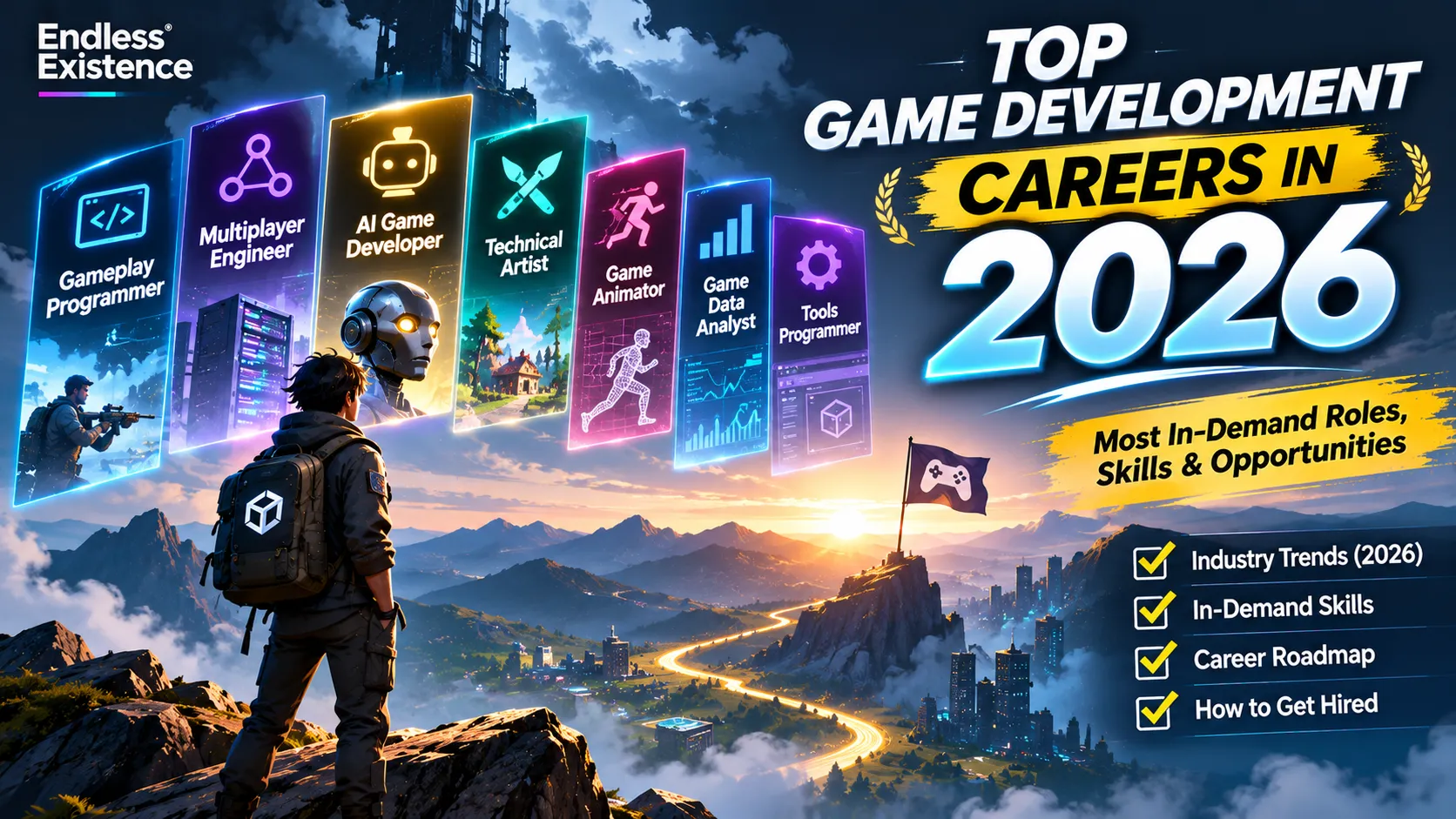
Traditional roles such as gameplay programmer, 3D artist, and game designer remain important. However, new technologies and changing production strategies are creating opportunities in multiplayer engineering, AI-assisted development, technical art, game analytics, live operations, and development tools.
For aspiring developers, this raises an important question:
Which game development careers are actually in demand in 2026, and which skills should you learn to build a successful career?
The answer is not as simple as choosing Unity, Unreal Engine, or Blender.
Studios increasingly need people who can solve specialized technical problems, build scalable systems, optimize production pipelines, and understand how players interact with games.
In this guide, we explore the most interesting game development career opportunities in 2026, examine current hiring trends, and identify the skills that can help you stand out.
1. The Game Development Job Market in 2026
Before choosing a career path, it is important to understand what is happening in the industry.
The game development job market has experienced significant changes over the past few years. Layoffs, changing production budgets, AI adoption, and increased competition have affected developers worldwide.
However, the market is not simply disappearing. Hiring demand is shifting between disciplines, regions, and experience levels.
What Current Industry Data Tells Us
Several recent reports provide useful insights.
GDC 2026 State of the Game Industry
The survey collected responses from more than 2,300 game industry professionals.
Among its findings:
- 28% of respondents had personally experienced layoffs within the previous two years.
- 50% said their current or most recent employer had conducted layoffs during the previous 12 months.
- 74% of surveyed students were concerned about their future job prospects.
- Programming represented 17% of respondents’ job disciplines.
- Visual and technical arts represented 16%.
These figures describe survey respondents, not the number of available vacancies. However, they illustrate why entering the industry requires careful preparation.
Current Job Posting Trends
A November 2026 snapshot from Alion’s game developer job tracker reported 5,745 open roles worldwide.
Among the frequently requested technical skills were:
| Skill | Open postings mentioning the skill |
|---|---|
| C++ | 1,102 |
| Python | 1,000 |
| Unity | 848 |
| Unreal Engine | 726 |
| C# | 683 |
| CI/CD | 492 |
| AWS | 476 |
| SQL | 406 |
| AI Agents | 261 |
These numbers represent skill mentions across collected job postings, not unique jobs exclusively dedicated to each technology.
The takeaway is clear: programming remains a major part of the industry, but demand extends into infrastructure, automation, data, and AI-related workflows.
2. The Most In-Demand Game Development Careers in 2026
Let’s explore the career paths worth paying attention to.
1. Gameplay Programmer
<badge color=”success”>Strong foundational career</badge>
What they do: Build the systems that make games playable.
Gameplay programmers implement the mechanics and interactions players experience.
Typical responsibilities include:
- Player movement and controls.
- Combat and weapon systems.
- Enemy behavior.
- Inventory and progression.
- Character abilities.
- Interaction systems.
- Gameplay balancing.
- Animation integration.
Essential skills:
- C++ or C#.
- Unity or Unreal Engine.
- Object-oriented programming.
- Data structures and algorithms.
- Physics and mathematics.
- State machines.
- Debugging and optimization.
Why this career matters in 2026:
Even with AI-assisted coding, games still need developers who understand how gameplay systems work together.
A generated movement script is easy to produce. Building a responsive movement system that works across different characters, environments, network conditions, and platforms is a much more complex engineering challenge.
Best engines: Unity and Unreal Engine.
2. Multiplayer and Network Engineer
<badge color=”success”>High-value specialization</badge>
What they do: Build the technology that allows multiple players to interact reliably.
Online multiplayer remains an important part of modern game development.
Unity’s 2026 Game Development Report found that 83% of surveyed developers were working with online multiplayer features. Cross-play was also a priority for many studios.
Multiplayer engineers work on:
- Client-server architecture.
- Network synchronization.
- Server authority.
- Prediction and interpolation.
- Matchmaking.
- Lobby systems.
- Player authentication.
- Lag compensation.
- Anti-cheat systems.
Essential skills:
- C++ or C#.
- Networking fundamentals.
- TCP, UDP, and WebSockets.
- Distributed systems.
- Latency optimization.
- Backend architecture.
- Cloud infrastructure.
Why it is interesting:
Multiplayer development requires specialized knowledge that goes beyond ordinary gameplay programming.
Developers who understand networking, server architecture, and performance can work on competitive shooters, co-op games, MMORPGs, sports games, and online platforms.
Best engines: Unreal Engine and Unity.
3. Technical Artist
<badge color=”success”>Strong creative-technical opportunity</badge>
What they do: Connect artistic production with technical development.
Technical artists solve problems between the art and engineering teams.
They help ensure that visual assets look good while remaining efficient and compatible with the game’s rendering pipeline.
Responsibilities may include:
- Shader development.
- Material creation.
- Lighting optimization.
- Character rigging.
- Animation pipelines.
- Procedural asset workflows.
- VFX development.
- Performance optimization.
Essential skills:
- Blender or Maya.
- Unity Shader Graph or Unreal materials.
- HLSL.
- Python.
- Lighting and rendering.
- Animation systems.
- GPU profiling.
Why this career is interesting:
Modern games require increasingly complex visual production pipelines.
Technical artists help teams achieve visual quality without sacrificing performance.
The role is especially valuable for developers who enjoy both programming and artistic work.
4. AI Game Developer
What they do: Integrate intelligent systems into game development and gameplay.
AI-related careers are expanding, but it is important to distinguish between two different areas.
Traditional game AI
This involves building intelligent gameplay behavior.
Examples include:
- NPC decision-making.
- Enemy behavior.
- Pathfinding.
- Behavior Trees.
- Utility AI.
- Procedural generation.
- Dynamic difficulty.
Generative AI integration
This involves using machine learning models and AI services inside development tools or actual games.
Examples include:
- AI-driven dialogue.
- Generative character interactions.
- Intelligent content-authoring tools.
- AI-assisted animation workflows.
- Development automation.
- LLM-powered NPC prototypes.
Essential skills:
- Python.
- C# or C++.
- Machine learning fundamentals.
- API integration.
- Data processing.
- Game AI architecture.
- Prompt and agent workflow design.
A realistic market perspective:
AI is an important emerging skill, but it should not be confused with the largest category of game industry employment.
One November 2026 job-posting snapshot identified AI-related skills in approximately 4.7% of tracked listings.
This suggests that AI knowledge can provide an advantage, but it is not yet a replacement for foundational engineering, art, and production skills.
5. Game Tools and Pipeline Programmer
What they do: Build tools that make game development faster and more reliable.
Large projects often require custom tools that are not included in the game engine.
Tools programmers create systems for:
- Level editing.
- Asset processing.
- Automated builds.
- Internal debugging.
- Animation workflows.
- Data validation.
- Custom editor extensions.
- Development automation.
Essential skills:
- C++ or C#.
- Python.
- Editor scripting.
- Software architecture.
- Build automation.
- Git.
- CI/CD pipelines.
- API development.
Why this career matters:
A tool that saves five minutes for one developer might save hundreds of hours across an entire studio.
This is why experienced teams invest in improving their internal production pipelines.
AI agents are also making this area more interesting because developers can build tools that automate repetitive tasks and connect different stages of production.
6. Game Technical Animator
What they do: Develop and maintain animation systems that work reliably in games.
Animation is not just about creating attractive character movements.
Technical animators ensure that animations work correctly inside the engine and interact properly with gameplay.
Responsibilities include:
- Character rigging.
- Animation retargeting.
- Motion capture cleanup.
- Animation state machines.
- Procedural animation.
- Inverse kinematics.
- Runtime animation systems.
Essential skills:
- Maya or Blender.
- Unity Animator or Unreal Animation Blueprints.
- Rigging.
- Motion capture.
- Python.
- Animation mathematics.
Why it is trending:
Animation remains a major requirement across games, cinematic production, and interactive experiences.
A November 2026 industry job-posting snapshot from Navisca identified animation in approximately 34% of its tracked postings.
That figure is a skill mention across listings, not the percentage of all game jobs that are animator positions.
7. Game Data Analyst
What they do: Understand player behavior through data.
Modern games generate enormous amounts of player interaction data.
Studios use this information to understand why players continue playing, where they stop progressing, and which features generate engagement.
Responsibilities include:
- Player retention analysis.
- Engagement measurement.
- Monetization analysis.
- A/B testing.
- Player segmentation.
- Game economy analysis.
- Dashboard development.
Essential skills:
- SQL.
- Python.
- Statistics.
- Data visualization.
- Analytics platforms.
- Experiment design.
- Game design fundamentals.
Why this career matters:
Live-service games need to understand their players continuously.
Developers and analysts who can translate player data into useful design decisions are valuable to teams operating games over long periods.
8. Live Operations Developer
What they do: Maintain and improve games after launch.
Game development does not end when a game is published.
Live Operations, commonly called LiveOps, focuses on maintaining player engagement and delivering new experiences.
Responsibilities include:
- Seasonal events.
- Daily and weekly missions.
- In-game rewards.
- Limited-time content.
- Economy updates.
- Remote configuration.
- Player segmentation.
- Event analytics.
Essential skills:
- Unity or Unreal.
- Backend integration.
- REST APIs.
- SQL.
- Analytics.
- Game economy design.
- Data-driven development.
Unity’s 2026 report highlights that studios are increasing their focus on post-launch content and LiveOps.
This makes LiveOps an interesting specialization for developers who enjoy combining programming, analytics, and game design.
9. Graphics and Rendering Programmer
What they do: Develop the technology responsible for a game’s visual rendering.
Graphics programmers work on how a game uses the GPU and rendering pipeline.
Their work may include:
- Custom rendering systems.
- Shader development.
- Global illumination.
- GPU optimization.
- Lighting systems.
- Visual effects.
- Rendering performance.
- Advanced graphics features.
Essential skills:
- C++.
- HLSL or GLSL.
- Linear algebra.
- GPU architecture.
- Rendering mathematics.
- Graphics APIs.
- Performance profiling.
This is one of the more technically demanding specializations, but it can be an excellent direction for developers who enjoy mathematics and low-level programming.
10. QA Automation Engineer
What they do: Build systems that automatically detect game defects.
Quality Assurance is evolving beyond manually testing every feature.
QA automation engineers create tools and scripts to test games more consistently.
Typical responsibilities include:
- Automated gameplay tests.
- Regression testing.
- Build validation.
- Performance testing.
- Test automation frameworks.
- Bug reproduction.
- Continuous integration.
Essential skills:
- Python, C#, or C++.
- Automated testing.
- Game engine testing tools.
- Git.
- CI/CD.
- Debugging.
- Test design.
This can be an interesting entry point for people who enjoy problem-solving and software testing.
3. Which Game Development Careers Are Growing the Fastest?
There is no single globally accepted ranking of the fastest-growing game development careers.
However, combining current hiring snapshots with industry reports reveals several areas worth watching.
| Career area | Why it deserves attention |
|---|---|
| Multiplayer engineering | Online gameplay and cross-play |
| Technical art | Increasingly complex visual pipelines |
| AI integration | Automation and intelligent features |
| Tools programming | Faster production workflows |
| Game analytics | Player retention and monetization |
| LiveOps | Continuous post-launch development |
| Animation technology | Character and motion systems |
| QA automation | More efficient testing pipelines |
An important distinction: these are areas with meaningful industry activity and technical relevance, not a verified ranking of global job growth.
4. Which Programming Languages Should Game Developers Learn?
Your choice of programming language depends on your career direction.
Here is a practical comparison.
| Language | Common game development uses |
|---|---|
| C++ | Unreal, engine programming, graphics |
| C# | Unity, gameplay systems, tools |
| Python | Automation, pipelines, AI, data |
| Lua / Luau | Roblox gameplay development |
| JavaScript / TypeScript | Web games and game-related tools |
| HLSL / GLSL | Graphics programming and shaders |
My Recommendation
If you want to become a gameplay programmer, start with C# or C++.
If you want to work in Unity, focus on C#.
If you want to work in Unreal, learn C++ and Unreal’s gameplay architecture.
If you are interested in AI and automation, Python is an excellent additional skill.
Do not try to learn every programming language simultaneously.
A strong understanding of one language is more useful than shallow knowledge of six.
5. Which Game Engine Should You Learn in 2026?
The best engine depends on the type of games you want to develop.
Unity
Best for:
- Mobile games.
- Indie games.
- Cross-platform projects.
- Simulation.
- XR applications.
- 2D and 3D games.
Unity uses C# and provides a broad ecosystem for game development.
Unreal Engine
Best for:
- High-end PC and console games.
- Large 3D environments.
- Advanced rendering.
- Cinematic experiences.
- Complex multiplayer projects.
Unreal supports C++ and visual scripting through Blueprints.
Godot
Best for:
- Indie development.
- 2D games.
- Lightweight 3D projects.
- Open-source workflows.
Godot offers GDScript, C#, and other language options depending on the project and platform.
Roblox Studio
Best for:
- User-generated games.
- Social multiplayer experiences.
- Simulation games.
- Virtual experiences.
- Rapidly building interactive experiences.
Roblox uses Luau and provides an integrated publishing and distribution ecosystem.
Important: Learning one engine deeply is usually a better starting point than constantly switching between engines.
6. AI Is Changing Game Development Careers
AI is becoming part of modern game production.
Developers are using AI tools for coding assistance, research, prototyping, content generation, and automation.
The GDC 2026 report found that 36% of surveyed game industry professionals used generative AI tools as part of their jobs.
However, sentiment is mixed: 52% of respondents believed generative AI was having a negative impact on the industry.
This means developers should understand both the opportunities and limitations of AI.
Skills That Become More Important in an AI-Assisted Workflow
System architecture
AI can generate individual scripts, but understanding how a complete system should work remains essential.
Debugging
You need to identify why generated code fails and how to correct it.
Code review
Generated code can introduce security issues, performance problems, or architectural inconsistencies.
Technical communication
You must explain requirements clearly to both human teammates and AI tools.
Testing
AI-generated implementations need to be tested under realistic gameplay conditions.
The Best Strategy
Do not build your career around knowing one AI tool.
Build a strong technical foundation and learn how to use AI as a development assistant.
Tools will change. Engineering fundamentals will remain valuable.
7. Which Game Development Career Is Best for Beginners?
Not every career path has the same learning curve.
Some specializations require advanced mathematics, networking, or years of technical experience.
Here is a practical starting comparison.
| Career | Starting difficulty | Good first focus |
|---|---|---|
| Gameplay Programmer | Medium | C# or C++ and game mechanics |
| QA Tester | Beginner–Medium | Testing and debugging |
| Technical Artist | Medium–High | Blender and engine rendering |
| Game Designer | Medium | Game systems and prototyping |
| Game Animator | Medium | Animation and rigging |
| Game Tools Programmer | High | Programming and automation |
| Multiplayer Engineer | High | Networking and backend |
| Graphics Programmer | Very High | C++, mathematics, shaders |
| Game Data Analyst | Medium–High | SQL, Python, statistics |
These are general learning-path estimates, not formal hiring requirements.
My Suggested Beginner Path
If you are completely new to game development:
- Learn programming fundamentals.
- Choose one game engine.
- Build small gameplay systems.
- Complete a playable game.
- Learn Git and version control.
- Choose a specialization.
- Build a portfolio around that specialization.
Avoid spending years learning tools without finishing projects.
8. How to Build a Portfolio That Attracts Game Studios
A good portfolio demonstrates your ability to solve real development problems.
You do not need ten unfinished projects.
You need a few strong projects that communicate your abilities.
If You Want to Become a Gameplay Programmer
Build a project featuring:
- Character movement.
- Combat.
- Enemy AI.
- Inventory.
- Save system.
- Progression.
If You Want to Become a Multiplayer Engineer
Build:
- Multiplayer lobby.
- Networked player movement.
- Server-authoritative combat.
- Player synchronization.
- Matchmaking prototype.
If You Want to Become a Technical Artist
Showcase:
- Custom shaders.
- Materials.
- Lighting.
- Procedural environments.
- Optimized assets.
- Animation systems.
If You Want to Become an AI Game Developer
Build:
- AI-powered NPC prototype.
- Dialogue system.
- AI development tool.
- Automated gameplay testing system.
What to Include
Every portfolio project should ideally have:
- Gameplay video.
- Screenshots.
- Technical explanation.
- Tools and technologies.
- Your personal contribution.
- Challenges and solutions.
- Playable build.
- Source code or selected code samples.
Do not simply upload a project and expect employers to understand its quality.
Explain what you built and why your implementation matters.
9. Where Are Game Development Jobs Located in 2026?
Game development is a global industry, but hiring opportunities are not evenly distributed.
A November 2026 analysis of global game job openings by Amir Satvat, reported by GamesBeat, highlighted a growing share of opportunities in Asia-Pacific.
The analysis estimated that APAC represented approximately 47% of global open game roles in its tracked market, compared with 31% in 2024.
It also reported that the share of truly global remote positions had declined from 15% to 4%.
These are estimates from a specific job-tracking methodology, not a complete census of every vacancy.
Nevertheless, the findings highlight an important point: developers should not assume that remote opportunities are as widely available as they once were.
Regions Worth Exploring
North America
- United States.
- Canada.
Europe
- United Kingdom.
- Poland.
- Germany.
- France.
- Spain.
Asia-Pacific
- Japan.
- China.
- South Korea.
- India.
- Singapore.
For developers in Bangladesh, remote roles and international freelance opportunities are worth exploring, but relocation, time zones, payment arrangements, and employer hiring policies can affect eligibility.
Useful Job Platforms
- LinkedIn Jobs.
- Work With Indies.
- Hitmarker.
- GamesJobsDirect.
- GameJobs.co.
- Official studio career pages.
- Always Supporting the Game Community.
Do not rely exclusively on general job boards. Some studios publish opportunities only on their own websites.
10. How to Get Your First Game Development Job
Getting the first opportunity can be the hardest part of a game development career.
A practical approach is to build evidence of your skills before applying.
Step 1: Choose a Specialization
Do not present yourself as someone who can do everything.
Choose a primary role such as:
- Unity Gameplay Programmer.
- Unreal Engine Developer.
- Technical Artist.
- Multiplayer Engineer.
- Game QA Automation Engineer.
Step 2: Learn the Required Technologies
Study the skills repeatedly mentioned in job descriptions for your target role.
Step 3: Build Two or Three Strong Projects
Focus on finished projects that demonstrate real technical ability.
Step 4: Prepare a Professional CV
Include:
- Technical skills.
- Relevant projects.
- Programming languages.
- Game engines.
- Work experience.
- GitHub and portfolio links.
Step 5: Apply Strategically
Apply to junior positions, internships, smaller studios, and relevant contract opportunities.
Read the requirements carefully and adapt your application to each role.
Step 6: Practice Technical Interviews
Prepare for:
- Programming questions.
- Engine-specific questions.
- Problem-solving exercises.
- Architecture discussions.
- Portfolio demonstrations.
Step 7: Keep Building
If you do not receive an offer immediately, use the feedback and experience to improve your projects and technical knowledge.
11. A 12-Month Roadmap for Starting a Game Development Career
Here is a practical roadmap for someone starting with basic programming knowledge.
| Period | Main objective |
|---|---|
| Months 1–2 | Programming fundamentals |
| Months 3–4 | Learn one engine deeply |
| Months 5–6 | Build complete gameplay projects |
| Months 7–8 | Choose a specialization |
| Months 9–10 | Build a specialization-focused portfolio |
| Months 11–12 | Prepare CV, interviews, and applications |
Months 1–2: Build Your Foundation
Learn C#, C++, or another language relevant to your chosen engine.
Practice problem-solving and understand programming fundamentals.
Months 3–4: Learn the Engine
Understand scenes, objects, components, physics, animation, UI, and scripting.
Build small prototypes without relying entirely on tutorials.
Months 5–6: Build Complete Games
Complete one or two small games.
Learn how to handle bugs, optimize performance, and publish a playable build.
Months 7–8: Choose Your Specialization
Focus on gameplay, networking, technical art, AI, tools, or another direction.
Months 9–10: Build Your Portfolio
Create projects that demonstrate specialized knowledge.
Document your development process.
Months 11–12: Prepare for Employment
Build a CV, publish your portfolio, practice interviews, and start applying.
This is a structured learning plan, not a guarantee of employment within one year. Your progress will depend on your existing experience and the time you can invest.
12. Final Thoughts: Which Game Development Career Should You Choose?
The game development industry is becoming more specialized.
Programming, technical art, animation, networking, AI, analytics, and development tools all provide interesting career opportunities.
However, there is no universally best career.
The right choice depends on your strengths, interests, and the kind of problems you enjoy solving.
If you love building gameplay systems, become a gameplay programmer.
If you enjoy visual technology, explore technical art or graphics programming.
If you like networking and complex architecture, consider multiplayer engineering.
If you enjoy automation and intelligent systems, explore AI integration and tools programming.
Most importantly, do not choose a career simply because someone calls it the next big trend.
Choose a specialization, build real projects, develop deep skills, and demonstrate your abilities.
The developers who stand out in 2026 will not simply know how to use game engines. They will understand how to solve the problems that make great games possible.
Frequently Asked Questions
1. Which game development career is most in demand in 2026?
Programming and engineering remain major areas of game industry employment. Gameplay, engine, networking, and tools programming are worth exploring, while technical art, animation, analytics, and AI integration offer additional opportunities.
2. Is game development still a good career in 2026?
Yes, but the industry is competitive. Strong technical skills, completed projects, specialization, and the ability to adapt to modern production tools are important.
3. Will AI replace game developers?
AI can automate parts of coding, research, prototyping, and content creation. However, complex architecture, gameplay decisions, testing, optimization, and production responsibility still require human expertise.
4. Should I learn Unity or Unreal Engine for a career?
Both are valuable. Unity is widely used in mobile games, indie projects, and cross-platform development. Unreal is prominent in high-end PC and console production. Choose based on your target roles.
5. Is multiplayer game development a good specialization?
It can be an excellent specialization for developers interested in networking, distributed systems, and online gameplay. However, it requires deeper technical knowledge than basic single-player development.
6. Can I become a game developer without a university degree?
Yes, depending on the employer and role. A strong portfolio, practical experience, and demonstrable technical skills can help compensate for the absence of a formal degree, although some employers have specific education requirements.
7. What programming language should I learn first?
C# is a good choice for Unity development, while C++ is important for Unreal and lower-level engine programming. Python is useful for automation, AI, and data-related workflows.
8. Are remote game development jobs available?
Yes, but fully global remote positions are competitive and represent only part of the market. Many employers prefer candidates in particular countries or time zones.