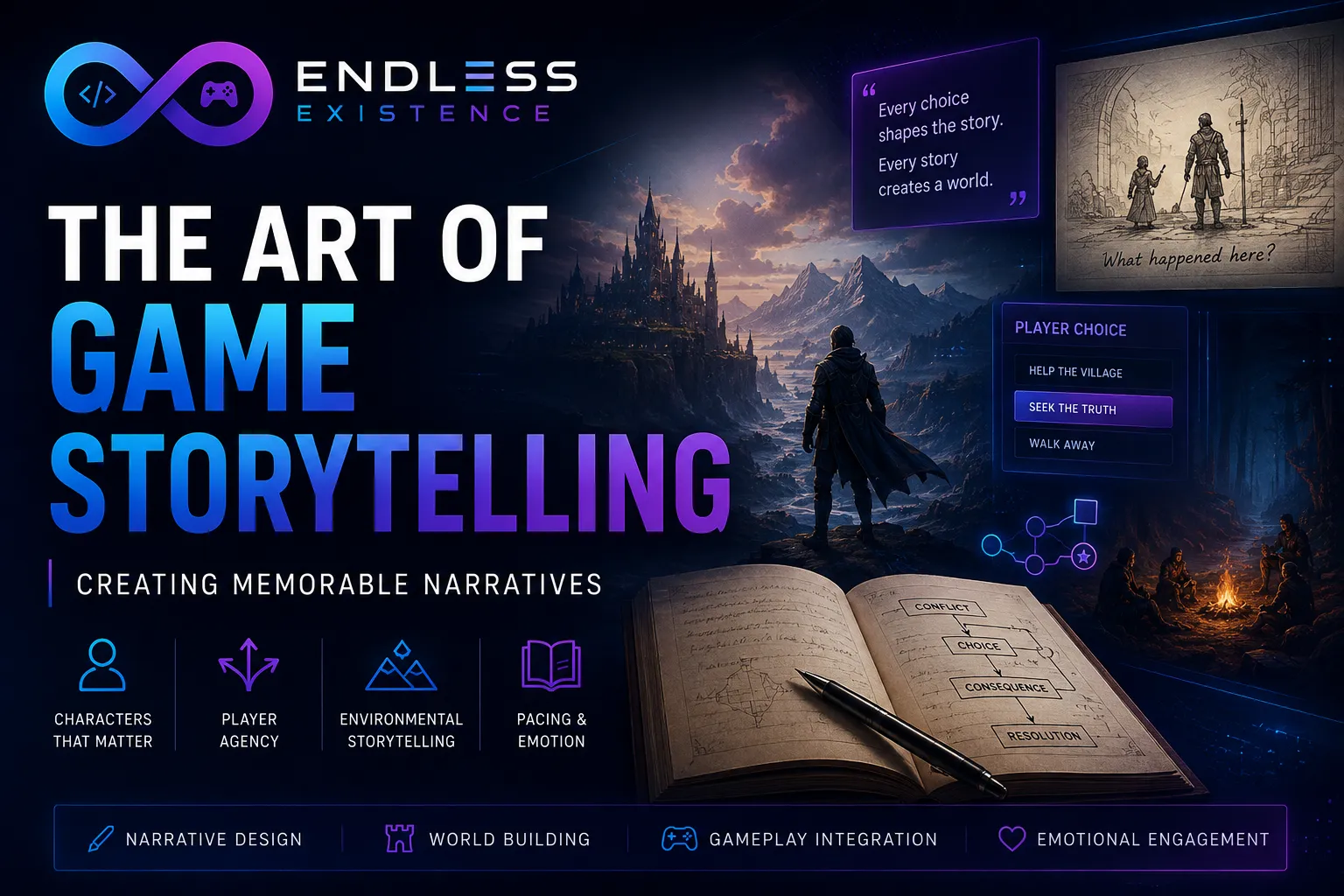
Great game storytelling is not simply a movie script placed between gameplay sections.
Games are interactive, which means their stories can be communicated through player actions, mechanics, characters, environments, choices, dialogue, objectives, and consequences. The strongest game narratives make these elements work together rather than treating gameplay and story as completely separate systems.
This is where game storytelling differs from storytelling in largely linear media such as novels and films.
A developer is not only asking:
“What story do I want to tell?”
They also need to ask:
“What will the player do, discover, and experience that communicates this story?”
In this guide, we will explore the fundamentals of game storytelling and practical techniques you can use to create narratives that players remember.
What Is Game Storytelling?
Game storytelling is the process of communicating narrative through the player’s experience of a game. It can combine traditional elements such as characters, dialogue, conflict, and plot with interactive elements such as gameplay mechanics, exploration, player choices, environments, and consequences.
That distinction is important.
A game can tell part of its story through a cinematic, but it can also communicate narrative when the player:
- explores an abandoned environment;
- makes a difficult decision;
- discovers an optional piece of information;
- sees an NPC react to an earlier action;
- gains or loses an ability;
- completes an objective;
- interacts with the game’s systems.
In other words, the playable experience itself can become part of the narrative.
Why Is Storytelling Important in Games?
Not every game needs an elaborate plot. However, narrative can give gameplay context and help players understand why their actions matter.
Effective game storytelling can contribute to several areas of the player experience.
Creates Context
Mechanics tell players what they can do. Narrative can help explain why they are doing it.
Collecting an object because a UI says 0/5 creates a mechanical objective.
Collecting five medical supplies because a settlement desperately needs them gives the same mechanic narrative context.
Strengthens Immersion
Story, art direction, level design, sound, characters, and mechanics can work together to make a fictional world feel coherent.
Immersion does not necessarily require photorealistic graphics or hours of dialogue. Consistency between the game’s systems and fictional world is often more important.
Creates Emotional Investment
Players may become invested in characters, relationships, locations, conflicts, or outcomes.
That investment gives developers opportunities to make victories, failures, discoveries, and choices more meaningful.
Gives Player Actions Meaning
One of the unique strengths of games is participation.
Instead of only watching events unfold, players frequently perform actions within the story. Even games with mostly linear narratives can create a sense of involvement through exploration, combat, puzzle solving, dialogue, or other mechanics.
The Core Principles of Effective Game Storytelling
Memorable game narratives usually depend on more than a surprising plot.
Developers need to think about the relationship between character, conflict, player agency, gameplay, worldbuilding, pacing, and narrative delivery.
Here are the most important principles.
1. Build Characters Around Goals and Conflict
A long backstory does not automatically create an interesting character.
Start with three questions:
- What does this character want?
- Why do they want it?
- What prevents them from getting it?
These questions create motivation and conflict.
For example, imagine an NPC who wants to protect their village.
That is functional, but still fairly generic.
Now add conflict:
- protecting the village requires cooperating with an enemy;
- the character distrusts outsiders;
- their previous decisions contributed to the current crisis.
The character now has competing motivations.
Give Characters Strengths and Flaws
Characters become more believable when their positive traits can also create problems.
A loyal character might refuse to abandon someone even when retreat is the logical choice.
A highly ambitious character may accomplish extraordinary things while damaging important relationships.
These contradictions create opportunities for drama.
Let Characters Change
Character development becomes stronger when experiences affect future behavior.
Instead of telling players that someone has changed, demonstrate it through:
- dialogue;
- decisions;
- animations;
- gameplay behavior;
- relationships;
- environmental details.
Games are especially good at showing development through repeated interaction.
2. Connect Narrative to Gameplay
One of the most important principles of game storytelling is simple:
Whenever possible, let players experience important narrative ideas through gameplay instead of only explaining them through dialogue or cutscenes.
Suppose your game is about survival in an increasingly dangerous environment.
You could repeatedly tell players that resources are disappearing.
Or the systems themselves could communicate it:
- safe areas become less common;
- useful supplies become harder to find;
- NPC behavior changes;
- previously reliable routes become dangerous;
- the player’s available choices become more difficult.
The gameplay is now reinforcing the narrative.
This does not mean cutscenes are bad. Cutscenes, dialogue, text, and cinematics are valuable tools.
The goal is simply to avoid making them the only way the game communicates its story.
When planning the broader player experience, understanding level design principles can also help you connect environments, pacing, objectives, and narrative more effectively.
3. Understand Player Agency
Player agency is the player’s perceived ability to make meaningful decisions or take meaningful actions within the game experience.
Agency does not require dozens of branching endings.
A linear game can still provide meaningful agency through:
- exploration;
- approach to objectives;
- dialogue;
- optional discoveries;
- gameplay strategies;
- relationships;
- resource decisions;
- moment-to-moment interaction.
The important question is:
What does the player meaningfully control?
Avoid Meaningless Choices
Imagine giving the player three dialogue choices:
- “Yes.”
- “Okay.”
- “Sure.”
If every option produces exactly the same response and communicates the same attitude, the choice provides little meaningful agency.
This does not mean every dialogue option needs to alter the ending.
Smaller choices can affect:
- character relationships;
- available information;
- immediate reactions;
- future dialogue;
- optional scenes;
- gameplay resources.
The consequence should match the importance of the decision.
4. Use Environmental Storytelling
Not every piece of narrative needs dialogue.
Environmental storytelling communicates information through the game world itself.
Developers can use:
- architecture;
- props;
- lighting;
- sound;
- object placement;
- damage or decay;
- abandoned spaces;
- NPC behavior;
- visual composition;
- interactive objects.
Imagine the player enters an abandoned research laboratory.
You could display a paragraph explaining what happened.
Alternatively, the environment might contain:
- emergency lights;
- overturned equipment;
- locked containment rooms;
- hastily abandoned workstations;
- damaged machinery;
- unusual marks leading toward another area.
The player begins asking:
What happened here?
That question turns exploration into storytelling.
Environmental storytelling is particularly useful because it allows players to discover information through interaction rather than forcing every detail into exposition.
5. Control Narrative Pacing
Games need pacing just as much as films or novels, but game pacing is more complicated because players influence how quickly they progress.
A player might:
- rush toward objectives;
- explore every room;
- spend an hour completing side content;
- repeatedly fail a difficult encounter;
- stop playing and return several days later.
Narrative design needs to account for this uncertainty.
Alternate Intensity
Constant action eventually becomes exhausting.
Constant exposition becomes slow.
A useful rhythm might look like:
Tension → Action → Release → Discovery → Decision → Escalation
The exact pattern depends on the genre, but contrast makes important moments more noticeable.
Protect Important Story Beats
Avoid delivering essential dialogue during moments when players are intensely focused on difficult gameplay.
If players must dodge hazards, manage several systems, and listen to critical exposition simultaneously, some of that information will probably be lost.
Use quieter moments when important information deserves attention.
6. Use Plot Twists Carefully
Plot twists can create memorable moments, but surprise alone does not make a good twist.
An effective twist should usually:
- fit established information;
- change the player’s understanding of previous events;
- create meaningful consequences;
- feel surprising without feeling completely arbitrary.
Foreshadow Without Revealing
Foreshadowing allows developers to place information that becomes more meaningful later.
The player may initially interpret an object, conversation, or event one way.
After the reveal, the same detail takes on another meaning.
That creates the satisfying feeling that the answer was present all along.
However, foreshadowing should not make the reveal obvious.
The goal is:
“I should have noticed that.”
Not:
“I predicted this three hours ago.”
7. Create Emotional Engagement Through Consequences
Developers sometimes try to create emotional scenes by adding dramatic music or tragic dialogue.
Those tools can help, but emotion is usually stronger when the player understands what is at stake.
Before an emotional payoff, establish:
- relationships;
- motivations;
- expectations;
- routines;
- player investment.
The player needs context before a moment can carry weight.
Let Players Build Relationships Through Play
Suppose an NPC accompanies the player for several hours.
Instead of relying entirely on cinematics, let the relationship develop through gameplay.
The NPC might:
- help solve problems;
- react to locations;
- remember earlier decisions;
- provide useful information;
- change behavior as trust develops.
Now the relationship belongs partly to the player’s experience rather than existing only in scripted scenes.
8. Build Worldbuilding Around What the Player Needs
A common mistake is creating enormous amounts of lore before establishing the actual player experience.
Worldbuilding is valuable, but players rarely need to know everything the developer knows.
Ask:
What does the player need to understand this moment?
Then provide that information naturally.
Worldbuilding can appear through:
- locations;
- clothing;
- architecture;
- terminology;
- factions;
- technology;
- traditions;
- NPC behavior;
- gameplay rules;
- optional discoveries.
This makes the world feel deeper without turning every conversation into a history lecture.
9. Match Narrative Technique to Game Genre
Different games need different storytelling strategies.
| Game Type | Useful Narrative Techniques |
|---|---|
| Linear action game | Character arcs, scripted sequences, environmental storytelling |
| RPG | Quests, dialogue, relationships, worldbuilding, player choices |
| Horror | Environmental clues, uncertainty, pacing, audio, restricted information |
| Puzzle game | Environmental storytelling, discovery, contextual objectives |
| Open-world game | Location-based stories, optional narratives, NPCs, environmental storytelling |
| Strategy game | Systemic events, factions, emergent stories, campaign context |
| Roguelike | Repeated discoveries, persistent lore, systemic or emergent narrative |
The narrative should support the game’s core experience rather than compete with it.
A Practical Game Storytelling Framework
When designing a narrative, start small.
You do not need a 100-page screenplay before prototyping.
Write down these seven elements:
| Question | Example |
|---|---|
| Who is the player? | An apprentice explorer |
| What do they want? | Find a missing expedition |
| What prevents them? | A changing underground ruin |
| What is the central conflict? | Escape versus discovering the truth |
| What does the player repeatedly do? | Explore, investigate, solve puzzles |
| How does gameplay express the story? | Each discovery changes available routes |
| What changes by the end? | The player’s understanding of the expedition |
This creates a basic narrative foundation that can evolve alongside development.
Example: Designing a Fantasy RPG Narrative
Imagine you are developing a fantasy RPG.
The protagonist returns home and discovers that several settlements are disappearing from official maps.
Instead of immediately explaining the entire mystery, you could structure the narrative progressively.
Step 1: Establish the Goal
Give the player a clear immediate objective:
Find out what happened to the nearest missing settlement.
The larger mystery can wait.
Step 2: Introduce Characters With Conflicting Motivations
Perhaps the player encounters:
- a commander who wants the investigation stopped;
- a scholar obsessed with the disappearances;
- a merchant benefiting from abandoned trade routes;
- survivors who disagree about what happened.
Each character should want something.
Step 3: Put Story Into Exploration
At the missing settlement, let players investigate.
Environmental details might contradict what NPCs previously told them.
Now exploration is performing narrative work.
Step 4: Connect Discoveries to Gameplay
Suppose the player learns that an ancient magical system is altering the landscape.
That revelation should affect more than dialogue.
It might change:
- navigation;
- available abilities;
- enemy behavior;
- quest routes;
- previously visited locations.
The narrative has changed the game itself.
Step 5: Introduce Meaningful Decisions
Eventually, the player might decide whether the system should be destroyed, controlled, or studied.
The strongest version of this decision would build on what the player has experienced throughout the game rather than appearing suddenly at the ending.
Examples of Effective Game Storytelling
Studying successful games can help developers understand how different narrative techniques work.
The Last of Us
The Last of Us demonstrates how character relationships can develop alongside gameplay.
The emotional core is not simply the larger post-apocalyptic conflict. Much of the narrative revolves around the evolving relationship between Joel and Ellie.
This gives the larger journey personal stakes.
BioShock
BioShock is frequently discussed for the way its narrative engages with player control and agency.
Its story demonstrates how a reveal can recontextualize actions the player has already performed.
That makes the interactive nature of the medium relevant to the narrative itself.
Red Dead Redemption 2
Red Dead Redemption 2 uses a long character arc, extensive NPC interaction, environmental detail, and changes within the game’s world to support Arthur Morgan’s story.
The player’s extended time with the gang also allows relationships and conflicts to develop gradually.
The Witcher 3: Wild Hunt
The Witcher 3 demonstrates how side quests can contribute to worldbuilding rather than feeling completely disconnected from the main narrative.
Many quests contain local conflicts and consequences that reinforce the morally complicated nature of the world.
Life Is Strange
Life Is Strange places decisions, relationships, and consequences near the center of its player experience.
It is a useful example of how interactive decisions can contribute to emotional investment even when the game’s broader narrative remains authored.
Common Game Storytelling Mistakes
Understanding what goes wrong can be as useful as studying successful examples.
Too Much Exposition
If characters constantly explain the world to each other, the story can begin to feel unnatural.
Better approach: distribute information across dialogue, gameplay, environments, and optional discoveries.
Separating Gameplay and Story Too Much
If the narrative says one thing while the mechanics encourage something completely different, the experience can feel inconsistent.
Better approach: identify what the game’s core mechanics communicate about the player and world.
Giving Every Character a Huge Backstory
Developers need enough information to understand their characters, but players do not need every detail.
Better approach: prioritize motivations and information relevant to the current experience.
Choices Without Meaning
Players quickly notice when apparently important decisions have no visible effect.
Better approach: create consequences appropriate to the scale of the decision.
Explaining Everything
Mystery requires unanswered questions.
Better approach: trust players to infer some information from context.
Writing the Entire Story Before Testing Gameplay
Narrative and gameplay frequently change during development.
Better approach: establish the core narrative, prototype the experience, and iterate.
A broader game design workflow can also help you think about recurring design problems before committing to expensive production decisions.
How to Test Your Game Narrative
A narrative that works in a document may behave differently when someone actually plays the game.
Playtesting should therefore evaluate narrative as well as mechanics.
Ask testers questions such as:
- What do you think is happening?
- What is your current objective?
- Why do you think your character is doing this?
- Which characters do you remember?
- Which information confused you?
- Did any decision feel meaningful?
- What do you think will happen next?
Do not immediately explain the correct answers.
The difference between what you intended and what the player understood is extremely valuable information.
Watch Player Behavior
Player behavior can reveal narrative problems that questionnaires miss.
For example:
- Players skipping dialogue may indicate poor timing or excessive exposition.
- Players missing important environmental details may mean those details need stronger visual guidance.
- Players forgetting characters may indicate weak introductions.
- Players misunderstanding objectives may indicate that narrative and gameplay goals are disconnected.
Iterate on these problems just as you would iterate on mechanics.
Game Storytelling Checklist
Before finalizing a narrative section, ask:
- Does the player understand their current goal?
- Does each important character want something?
- Is conflict driving the scene or quest?
- Can some exposition become gameplay or environmental storytelling?
- Do important player decisions have appropriate consequences?
- Does the gameplay reinforce the narrative?
- Are important story moments delivered when the player can pay attention?
- Is the world communicating information without constant explanation?
- Does the player have enough information to understand what matters?
- Have real players tested this section?
If several answers are no, the narrative probably needs another iteration.
Frequently Asked Questions
What is storytelling in games?
Storytelling in games is the use of narrative elements and interactive systems to communicate a story through the player’s experience. It can include characters, dialogue, cinematics, gameplay mechanics, environments, exploration, choices, objectives, and consequences.
What makes game storytelling different from movies?
Games allow players to participate in the experience. Players can explore environments, perform actions, make decisions, interact with systems, and sometimes influence narrative outcomes. Because of this interactivity, game storytelling must consider what the player does as well as what the player sees or hears.
What are the main elements of game storytelling?
Important elements include characters, goals, conflict, player agency, gameplay integration, worldbuilding, pacing, environmental storytelling, narrative structure, and consequences.
Not every game needs all of them in equal amounts.
Does every game need a story?
No.
Some games work extremely well with minimal explicit narrative. However, even games without traditional plots can use theme, environment, progression, characters, or contextual goals to give player actions meaning.
What is environmental storytelling?
Environmental storytelling communicates narrative through the game world rather than relying entirely on direct exposition. Developers can use architecture, props, lighting, sound, object placement, environmental changes, and other details to help players infer events and understand the world.
What is player agency in game storytelling?
Player agency describes the player’s ability—or perceived ability—to make meaningful actions or decisions within the game experience. Agency can involve major branching choices, but it can also come from exploration, problem-solving, dialogue, strategy, and smaller decisions.
How do you write a good game story?
Start with the player experience rather than writing a complete screenplay immediately.
Define:
- who the player is;
- what they want;
- what stands in their way;
- what they repeatedly do during gameplay;
- how those actions communicate the narrative;
- how characters and the world respond;
- what changes over the course of the experience.
Then prototype and playtest the narrative alongside the gameplay.
Final Thoughts
Memorable game storytelling is not primarily about writing more dialogue, creating longer cutscenes, or adding increasingly complicated lore.
It is about designing an experience where story and interaction support each other.
Strong characters give players someone to care about. Conflict gives their actions purpose. Environments allow players to discover stories for themselves. Player agency creates participation. Gameplay turns abstract narrative ideas into experiences.
The most useful question for a developer is therefore not simply:
“Is this a good story?”
Ask:
“Is this a good story to experience through play?”
That shift—from writing a story that players watch to designing a story they experience—is at the heart of effective game storytelling.