Unity 6.6 introduces changes to everyday development, including faster entry into Play Mode, native dictionary serialization, and new tools for inspecting builds. For beginners, the important question is which changes help your project—and what needs testing before an upgrade.
Unity announced the availability of version 6.6 on September 1, 2026. This article reviews selected features and provides a practical upgrade workflow using official information checked on October 5, 2026.
What Is Unity 6.6?
Unity 6.6 is a release within the Unity 6 series. Its internal version family is 6000.6, which you may see in the Editor, documentation, or release notes.
A version number helps you identify the environment a tutorial or package expects. It does not establish whether a particular project will work correctly after upgrading.
Before changing versions, check your project’s packages, plugins, target platform, and current behavior.
Unity 6.6 vs Unity 6.3 LTS
LTS means Long-Term Support. Unity currently lists Unity 6.3 LTS as supported until December 2027. Unity’s 6.6 announcement describes 6.6 as a supported release receiving support until the following release arrives.
For beginners, the choice depends on project needs:
| Situation | Practical starting point |
|---|---|
| Following a structured course | Use its supported version unless the instructor advises otherwise |
| Exploring new features in a small project | Evaluate Unity 6.6 |
| Maintaining a working game | Upgrade a separate copy first |
| Depending on third-party packages | Confirm their compatibility before choosing |
| Seeking a longer maintenance window | Evaluate Unity 6.3 LTS |
These are decision guidelines, not guarantees of compatibility or stability.
1. Faster Entry Into Play Mode
One significant change concerns what Unity reloads when you press Play.
For new Unity 6.6 projects, the default is now “Reload Scene only,” rather than reloading both the scripting domain and scene. Skipping domain reload is intended to make transitions into Play Mode faster.
Why This Matters
Game development involves repeated tests:
- Change a value or script.
- Enter Play Mode.
- Observe the result.
- Stop.
- Adjust and repeat.
Reducing the wait between editing and testing can improve that workflow. However, faster Editor entry should not be confused with higher frame rates in a published game.
The State-Reset Problem
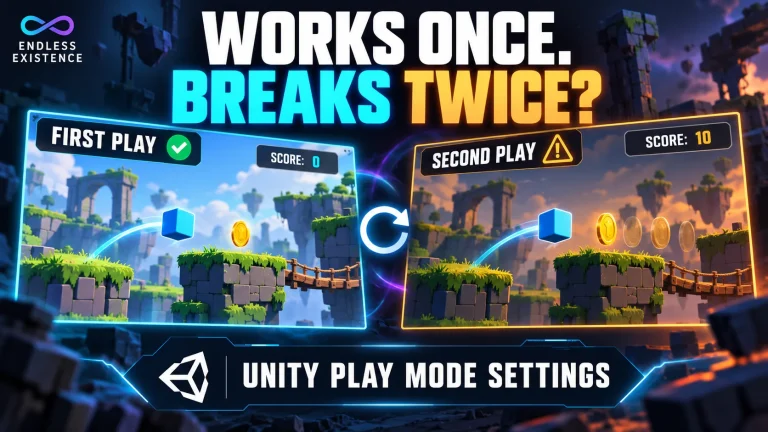
With domain reload disabled, static variables and static event subscriptions can persist between Play Mode sessions. Unity’s documentation explains that code must account for this persistence when a fresh state is required.
Consider a static score counter. If one test changes it from zero to five, a later test may retain that value unless the implementation resets it.
That behavior can make a second test differ from the first.
What Beginners Should Test
Run the same scenario several times without restarting the Editor.
Check whether:
- Session state starts correctly.
- Rewards are applied once.
- Event callbacks run the expected number of times.
- Managers retain references they should have cleared.
Then compare the behavior with a fresh application build. Repeated Editor tests and a newly launched application are different lifecycle conditions.
2. Native Dictionary Serialization
Unity 6.6 supports native serialization of Dictionary<TKey, TValue> fields with supported types. Serialized dictionaries can be edited in the Inspector using a key-and-value layout.
A dictionary associates a key with a value:
| Key | Value |
|---|---|
| Potion | 25 |
| Shield | 100 |
| Key | 10 |
This structure is useful when you need to look up information by an identifier.
A Beginner Use Case
Imagine a small shop where each item identifier maps to a price. A dictionary can express that relationship directly.
Before choosing the data structure, ask what the game needs. If items also have icons, descriptions, rarity, and other properties, a richer item definition may be more suitable.
Dictionary support reduces one implementation obstacle. It does not make dictionaries the right choice for every system.
Serialization Is Not a Player Save System
Inspector serialization and saving a player’s progress are separate concerns.
A field being serializable does not automatically create persistent saves, cloud storage, or multiplayer synchronization. Those features need their own design.
Also check documentation against your actual Editor version. An older tutorial may describe behavior that differs from Unity 6.6.
3. Build Analysis and Build History
Unity 6.6 adds a Build Analysis window and build-history reports for Player and content-directory builds.
Why Beginners Should Inspect Builds
During development, it is easy to focus only on the scene you see. The resulting build deserves inspection too.
If an update becomes unexpectedly larger, investigate before deleting assets randomly.
A practical comparison is:
- Build a working baseline.
- Record its size and relevant observations.
- Make one meaningful change.
- Build again.
- Compare the results.
For example, if adding a texture collection coincides with substantial growth, investigate its import settings and inclusion in the build.
The point is to connect a measured change with its likely cause.
4. Mobile UI Safe Areas
Unity 6.6 introduces a uGUI SafeArea component that adjusts a RectTransform according to the device’s reported safe area. It helps keep interface content away from display cutouts and system gesture regions.
Why This Matters
A pause button placed near the screen edge might look fine in the Editor but become awkward on a phone with a notch or a gesture area.
Safe-area handling addresses one part of that problem.
What It Does Not Solve
You still need to evaluate:
- Text size.
- Button spacing.
- Touch interaction.
- Aspect ratios.
- Portrait and landscape layouts.
A safe-area adjustment cannot determine whether a menu is understandable or a button is comfortable to use.
Keep decorative backgrounds and essential controls conceptually separate so each can follow appropriate layout rules.
5. More Detailed 2D Profiling
Unity 6.6 adds Profiler modules for 2D Animation, Tilemap, and 2D Graphics.
These provide additional places to investigate performance in a 2D project.
For a beginner, the useful habit is to measure a specific problem. Identify a reproducible slowdown, inspect the relevant activity, make one change, and compare again.
Do not assume animation, lighting, or tilemaps are responsible simply because the game uses them. A performance tool helps investigate a hypothesis; it does not replace one.
Should You Upgrade an Existing Project?
Upgrade when you can identify a benefit worth evaluating.
Possible reasons include a needed feature, a relevant fix, or a target-platform requirement. “The number is newer” is not enough to predict an improvement.
Unity provides a dedicated Unity 6.6 upgrade guide, which should be reviewed alongside package documentation.
A Practical Upgrade Workflow
1. Preserve the Working Version
Keep a recoverable copy or version-control checkpoint before opening the project in a different Editor.
Include the source assets, package configuration, and project settings needed to reconstruct it.
2. Record a Baseline
Build and test the current project. Note:
- Current errors and warnings.
- Important gameplay behavior.
- Representative performance.
- Build size.
- Known issues.
Otherwise, you may mistake an existing problem for an upgrade regression.
3. Upgrade a Separate Copy
Keep the comparison clean. Avoid combining the Editor upgrade with a major gameplay rewrite or asset replacement.
4. Investigate Failures Individually
Start with compilation and package problems. Then test startup, scene transitions, UI, input, saving, and other important systems.
Do not delete unfamiliar components merely to silence an error.
5. Test Repeated Play Sessions
Check first-run and subsequent-run behavior, especially where code uses static state or static events.
6. Test an Application Build
A project opening successfully in the Editor is only an early check. Verify the built application on the intended platform.
Which Features Should a Beginner Learn First?
Prioritize features according to your project:
| Project need | Feature to investigate |
|---|---|
| Slow edit-test cycles | Play Mode settings and state lifecycle |
| Key-based configuration data | Dictionary serialization |
| Unexpected build growth | Build Analysis |
| Mobile interface problems | Safe-area handling |
| A reproducible 2D slowdown | Relevant Profiler modules |
You do not need to adopt every new feature to benefit from the release.
Common Misunderstandings
| Claim | Correction |
|---|---|
| Faster Play Mode means the game runs at a higher FPS | Editor iteration speed and runtime performance are different measurements |
| Pressing Stop resets all scripting state | Domain-reload settings affect what persists |
| Serialized dictionaries automatically save player progress | Runtime persistence needs a separate implementation |
| Safe areas solve all mobile UI problems | Readability, layout, and interaction still need testing |
| A successful compilation proves the upgrade worked | Gameplay and builds must also be verified |
Frequently Asked Questions
Is Unity 6.6 Suitable for Beginners?
It can be used for beginner projects. Choose a version that fits your learning materials, package requirements, and project goals.
Should I Upgrade a Game Close to Release?
Evaluate the expected benefit against the time needed for compatibility checks and regression testing. A late upgrade should have a concrete justification.
Do I Need to Rewrite Every Script?
Do not assume that. Review the upgrade guide and investigate actual compatibility issues before changing working code.
Which Change Is Most Important to Understand?
The Play Mode default deserves early attention because it changes assumptions about state resetting during repeated tests.
Where Should I Check Version-Specific Behavior?
Use the documentation matching your installed Editor, its release notes, and the relevant package documentation. Record the exact version when asking for technical help.